
The vinyl-versus-digital argument is usually conducted as if one side must be lying. It does not need to be. Measured on the standard axes — noise, distortion, dynamic range, channel separation, speed accuracy — digital wins comprehensively and not narrowly. And yet a large number of careful, experienced listeners prefer records, and many of them are hearing something real. Reconciling those two statements requires separating the format from the release, and that turns out to explain most of the disagreement.
Where Digital Wins on the Numbers
The technical comparison is not close, and it is worth stating plainly before discussing why it is not the whole story.

Dynamic range. A 16-bit digital system offers around 96 dB, and with dither and noise shaping the usable range is greater still; 24-bit extends far beyond anything a room can use. A record is limited by surface noise at the bottom and by groove geometry at the top, giving perhaps 65–70 dB in practice on a clean pressing.
Channel separation. Digital channels are entirely independent. A stereo groove cuts both channels into one physical trench at 45 degrees, and a cartridge typically achieves 25–30 dB of separation, degrading at frequency extremes.
Distortion. A competent DAC measures below 0.001%. A cartridge tracing a groove is a mechanical system with real tracing error, and distortion rises steadily towards the inner grooves, where the linear velocity is lowest and the same waveform must be squeezed into less distance.
Speed stability. A digital clock is essentially perfect. A turntable has wow and flutter, however small, and a warped or off-centre record adds pitch variation you can sometimes hear on sustained piano notes.
Consistency. A digital file sounds identical on every play. A record wears, collects dust, and depends on stylus condition and alignment.
What Vinyl Genuinely Has
Two of vinyl's advantages are technical, and the rest are honest but not acoustic.
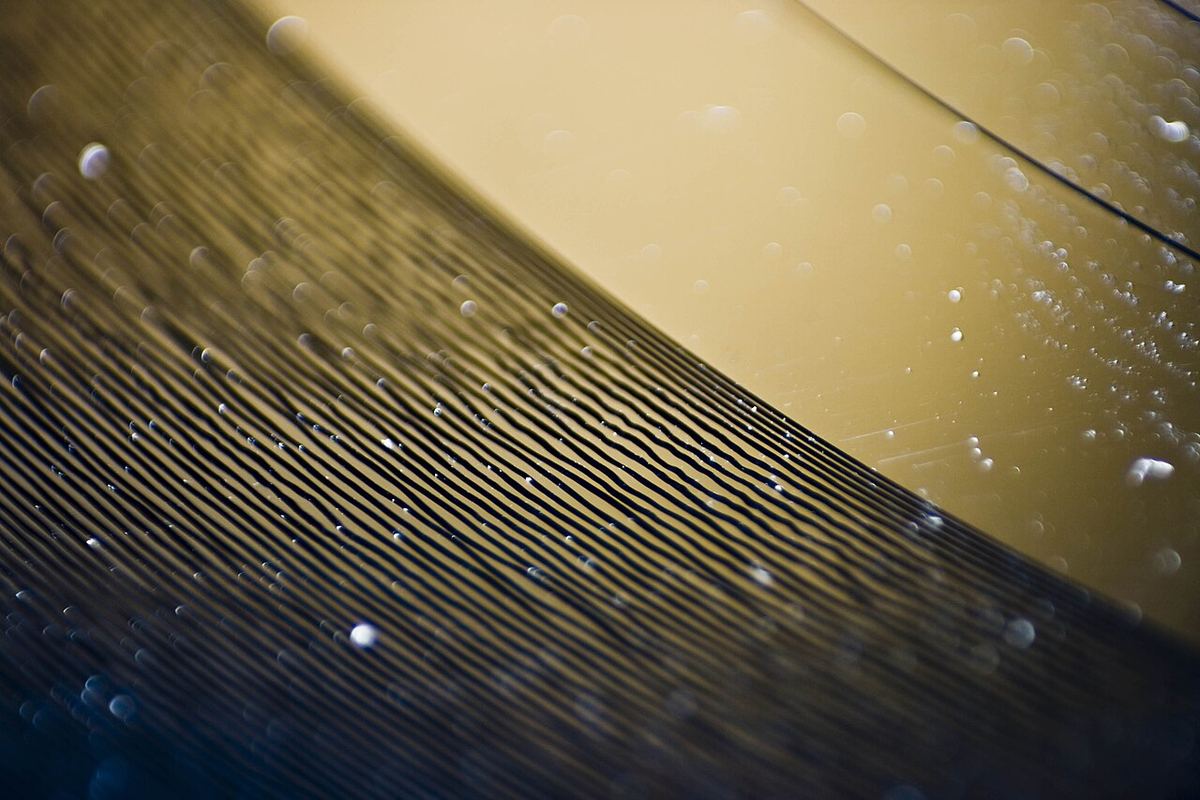
The first technical point is the absence of a brickwall filter and quantisation. A record is a continuous mechanical analogue of the waveform, with no sampling and no reconstruction filter. In practice this matters less than it sounds, because modern converters are transparent and the theoretical objections to sampling were resolved long ago — but it is a real structural difference rather than an invented one.
The second is the mastering constraint, and it is the important one. A record cannot be mastered as loudly as a CD. Excessive level, heavy bass content out of phase between channels, and aggressive limiting all cause the cutting head to misbehave and the stylus to mistrack. Cutting engineers therefore have to preserve dynamic range, roll bass towards mono, and control peaks. The format imposes restraint that digital does not.
It Is Usually the Master, Not the Medium
When a record sounds better than the streaming version of the same album, the most likely reason is that they are different masters. The CD or streaming release may have been compressed hard for loudness; the vinyl cut, constrained by the format, retains its dynamics. That is a genuine, audible difference — and it is a difference in mastering, not in the physics of the medium. The proof is available: play a vinyl rip alongside a well-mastered digital release of the same recording and the gap collapses.
RIAA Equalisation, and Why Records Need a Phono Stage
One mechanical constraint shapes the whole format. Low frequencies require large groove excursions; if they were cut at their natural level, bass notes would demand so much space that a side would hold only a few minutes, and the stylus would jump the groove. High frequencies, meanwhile, sit close to the surface noise floor.
The RIAA curve solves both: during cutting, bass is reduced and treble boosted, by roughly 20 dB each across the band. On playback, a phono stage applies the exact inverse, restoring flat response and simultaneously pushing the surface noise down along with the treble. It is an elegant solution, and it explains why a turntable cannot be plugged into a line input: without RIAA equalisation the sound is thin and shrill, and the level is far too low.
It also explains why the phono stage matters so much in a vinyl system. Any error in the equalisation curve is a direct frequency-response error, and the stage has to apply 40 dB or more of gain to a signal measured in millivolts — a demanding job in which noise performance is critical.
The Parts That Are Not About Sound
Much of vinyl's appeal is real without being acoustic, and there is no need to be embarrassed about it.
Playing a record is a deliberate act: choosing it, cleaning it, cueing the arm, turning it over halfway through. That structure encourages listening to an album as an album rather than as a shuffle queue, and attention is a genuine contributor to enjoyment. The physical object — sleeve, artwork, liner notes, twelve inches of it — carries information and pleasure that a thumbnail does not. And a record collection is finite and considered in a way a streaming library is not.
These are good reasons to own records. They are simply not evidence about frequency response, and conflating the two is what makes the argument circular.
Cost is not symmetrical either. A vinyl system's quality scales steeply with money: deck, arm, cartridge, phono stage, plus cleaning and eventual stylus replacement. A digital system reaches transparency cheaply and stops improving. Below roughly the price of a competent turntable, cartridge and phono stage together, digital will outperform vinyl on every measure — which makes budget an important part of the choice, not an afterthought.
Getting the Best From Each
Whichever you favour, most of the available quality comes from doing a few things properly.
- For vinyl: set the cartridge up precisely — alignment, tracking force, anti-skate, VTA — because setup errors dwarf equipment differences. Match the cartridge's compliance to the arm's effective mass. Load a moving-coil cartridge correctly at the phono stage. Keep records and stylus clean, and replace the stylus before it damages your collection.
- For digital: choose well-mastered releases, which matters far more than file resolution. Use a competent DAC and stop — the returns above modest prices are very small. Prefer asynchronous USB or a dedicated streamer over a computer's own outputs, and check that nothing in the chain is resampling or applying processing without your knowledge.
- For both: spend the marginal money on speakers, placement and the room, where it does more good than any format decision.
The honest conclusion is that there is no need to choose. A system with a good DAC and a good turntable gives you access to everything ever recorded plus the specific pleasure of records, and the two coexist happily on the same shelf. What is worth resisting is the belief that the format itself is doing the work — because once you know it is usually the master, you can go looking for good masters in either format.
The Inner-Groove Problem in Numbers
A record turns at a constant 33⅓ rpm, but the groove does not pass the stylus at a constant speed. At the outer edge of a 12-inch LP, around 146 mm from the centre, the groove moves at about 510 mm per second. At the innermost recorded groove, around 60 mm from the centre, it moves at about 210 mm per second — less than half the speed.
That matters because the same waveform must be squeezed into less groove. A 10 kHz tone occupies a wavelength of about 51 µm at the outer edge and only 21 µm at the inner. A conical stylus has a contact radius of around 15 µm, comparable to those inner wavelengths, so it cannot follow the finest modulations accurately and tracing distortion rises. Elliptical and line-contact styli, with a much smaller radius in the direction the groove travels, trace the inner grooves considerably better — one of the clearest technical reasons to choose a fine stylus profile.
The same arithmetic explains two familiar observations. Twelve-inch singles cut at 45 rpm move the groove 35% faster and often sound noticeably cleaner, which is why some audiophile reissues spread an album across two discs at 45. And long sides cost quality: fitting more than about 20 minutes onto a side requires tighter groove spacing, which in turn usually means a lower cutting level or reduced bass, and so more audible surface noise relative to the music.
What a Needle-Drop Tells You
One of the more revealing experiments available to any listener is a needle-drop: a careful digital recording of a record, made at 24-bit resolution through a good phono stage and analogue-to-digital converter. Played back, a good needle-drop retains the character people describe in the record — the dynamics of its master, its slight warmth, even its surface noise.
That result points somewhere useful. If a digital copy of a record still sounds like the record, then digital is perfectly capable of carrying what listeners value in vinyl, and the character must come from the master, the cutting process and the playback chain rather than from the absence of digital. It also means that the differences listeners hear between a record and a stream are real but are not evidence that one format captures something the other cannot.
Finding Good Masters in Either Format
If the master is what matters, choosing well becomes a matter of research rather than format loyalty. A few habits help.
- Check the source of a vinyl release. Much modern vinyl is cut from a digital master, often a high-resolution file. That is not a fault — but it does mean the record's appeal cannot be the absence of digital, and the same master may be available as a download.
- Compare dynamic range. Listener-maintained dynamic range databases list measurements for many different releases of the same album. A higher figure usually indicates less loudness compression, whichever format it appears on.
- Look beyond the latest remaster. Original CD releases from the 1980s and early 1990s often predate the worst of the loudness war and can be more dynamic than later remasters of the same album.
- Read pressing notes. For vinyl, the cutting engineer, the pressing plant and whether the cut came from tape or a file all affect the result more than the vinyl's weight or colour.
Quick Reference: Format Comparison
| Property | Vinyl | Digital (16-bit/44.1 kHz or better) |
|---|---|---|
| Dynamic range | ~65–70 dB in practice | 96 dB at 16-bit; more at 24-bit |
| Channel separation | 25–30 dB, worse at the extremes | Effectively complete |
| Distortion | Rises towards the inner grooves | Below audibility throughout |
| Speed accuracy | Wow, flutter, off-centre pressings | Clock-accurate |
| Wear | Record and stylus both wear | None |
| Mastering tendency | Constrained by the format; often more dynamic | Varies; often compressed for loudness |
| Cost to reach the format's ceiling | High — deck, arm, cartridge, phono stage | Low — transparency arrives cheaply |
Build the right chain for either format
Enter your components for a free analysis — cartridge loading and phono gain for vinyl, format support and connections for digital, and how the whole chain fits together.
Run a Free Analysis →