
No component in a hi-fi system has more interdependencies than the phono cartridge. It must be matched to the tonearm for correct resonance frequency, to the phono preamplifier for appropriate gain and loading, and to the stylus for correct alignment geometry. Get any of these wrong and the performance penalty is immediate and audible.
MM vs MC: The Fundamental Choice
The two dominant cartridge technologies — Moving Magnet (MM) and Moving Coil (MC) — produce sound through opposite mechanical arrangements, and each demands a completely different phono preamplifier.
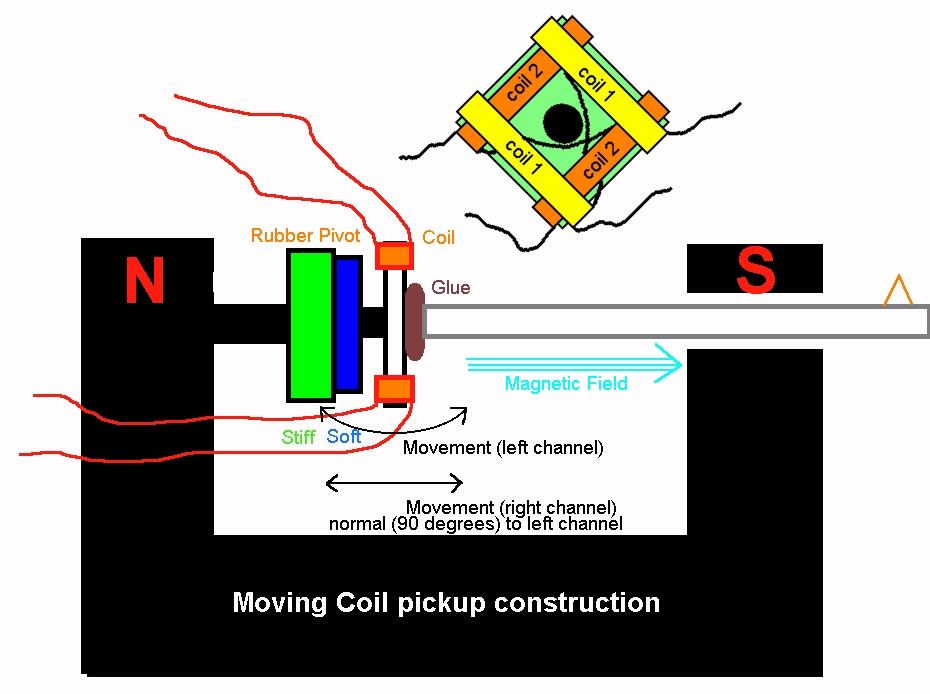
Moving Magnet (MM)
- Output voltage: 3–6 mV
- Internal impedance: 500–2,000 Ω
- Load impedance: 47 kΩ (standard)
- Phono gain needed: 35–45 dB
- Compliance: Typically medium-high (15–25 µm/mN)
- Stylus: User-replaceable
- Best with: Low-to-medium mass tonearms
Moving Coil (MC)
- Output voltage: 0.2–2.5 mV
- Internal impedance: 3–200 Ω
- Load impedance: 50–1,000 Ω (adjustable)
- Phono gain needed: 55–70 dB
- Compliance: Typically low-medium (5–15 µm/mN)
- Stylus: Requires factory retipping
- Best with: Medium-to-high mass tonearms
Output Voltage and Phono Stage Gain
Output Voltage (mV at a stated velocity)
Cartridge output is specified in millivolts at a reference groove velocity — typically 1 kHz at 5 cm/sec lateral velocity. This figure must match the gain and input sensitivity of your phono preamplifier. A low-output MC producing 0.35 mV cannot be used with a standard MM phono stage (which provides only 40 dB of gain) — it would need the 60+ dB of an MC stage. Conversely, a high-output MM at 5 mV fed into a high-gain MC stage will overdrive it.
Dynamic Compliance and Tonearm Resonance
Dynamic Compliance (10−⁶ cm/dyne or µm/mN at 100 Hz)
Dynamic compliance describes how freely the cartridge cantilever moves laterally. Combined with the tonearm's effective mass, it determines the tonearm-cartridge system resonance frequency. This resonance must land between 8 Hz and 12 Hz. Below 8 Hz it becomes susceptible to record warps. Above 12 Hz it encroaches on the audible range, adding a bass coloration and potential mistracking.
The resonance frequency formula is:
Tonearm–Cartridge Resonance Frequency
F = 1000 ÷ (2π × √(M × C))
Where F = resonance frequency (Hz), M = total effective mass (grams): tonearm effective mass plus cartridge and mounting screws, C = dynamic compliance (µm/mN)
For example: a cartridge with 12 µm/mN compliance and a total moving mass of 20 g (say, a 12 g arm carrying an 8 g cartridge and its screws) gives a resonance of approximately 10.3 Hz — ideal. Double the total to 40 g in a heavy arm and it drops to 7.3 Hz — too low, creating warp susceptibility. Reduce the total to 10 g and the resonance rises to 14.5 Hz — too high, audible coloration.
Practical rule: High-compliance cartridges (18+ µm/mN) need light tonearms (8–12 g effective mass). Low-compliance cartridges (below 10 µm/mN) need heavier tonearms (14–24 g). The AudioChainHiFi analyzer calculates this resonance frequency automatically.
Cartridge Loading
MM Loading: Capacitance Matters
MM cartridges are loaded at 47 kΩ input impedance — the universal standard. But MM cartridges also interact with the total capacitance of the phono cable plus the phono stage's input capacitance. The cartridge's internal inductance and this capacitance form a resonant circuit at the top of the audio range. Most MM cartridges are designed for 100–200 pF of total load capacitance. Too little capacitance and the high-frequency resonance rises, adding brightness. Too much and it shifts down into the treble, causing rolloff. Check the cartridge manufacturer's capacitance recommendation and measure (or estimate) the capacitance of your phono cable.
MC Loading: Resistance is the Variable
MC cartridges are loaded by the input impedance of the phono stage — typically a switch-selectable value from 50 Ω to 1,000 Ω or higher. The general rule is that the load impedance should be at least ten times the cartridge's internal impedance. A cartridge with 10 Ω internal impedance works well loaded at 100 Ω or above. Lower loading damps the cartridge and rolls off high frequencies; higher loading allows a natural resonance that some listeners find bright. The "correct" MC loading value often requires listening experimentation within the recommended range.
Stylus Profiles
The shape of the diamond tip affects how faithfully a cartridge traces the groove, and it is one of the clearest differences between budget and premium cartridges. The main profiles, from simplest to most advanced:
- Conical (spherical) — a rounded tip, typically about 0.6–0.7 mil in radius. Cheap, robust and forgiving of setup errors, but too large to follow the finest high-frequency modulations, especially near the label where the groove moves slowest. Still a sensible choice for worn or older records.
- Elliptical — narrower from side to side (often around 0.3 × 0.7 mil or finer), so it fits small wiggles better and reduces inner-groove distortion. The usual step up.
- Line-contact, Shibata, microline and similar — very fine side radii with a long, narrow contact line. They trace high frequencies most accurately and spread wear over a longer contact area, which often gives a longer life. The price is sensitivity to setup: alignment, rake angle and azimuth all matter more (see the cartridge setup guide).
Stylus Wear and Replacement
A stylus wears gradually, and a worn one damages records as well as sounding worse. Manufacturer guidance varies, but commonly quoted lifespans are a few hundred hours for conical and elliptical tips and around 800–1,000 hours or more for advanced line-contact profiles, assuming clean records and correct tracking force. Dirty records and incorrect tracking force shorten that considerably.
The early signs are easy to miss because they arrive slowly: sibilants ("s" and "t" sounds) becoming spitty or smeared, more distortion on loud passages and inner tracks, and the stylus collecting dirt more readily. A jeweller's loupe or an inexpensive USB microscope will show flat facets on a worn tip. With most moving-magnet cartridges, replacement is simple and inexpensive — the stylus assembly slides out and a new one slides in. Moving-coil cartridges usually need to go back to the maker or a specialist for retipping, or be exchanged under a trade-in programme, which is a real running cost to factor in.
High-Output MC, Moving Iron, and Step-Up Transformers
The MM/MC split is not as rigid as the comparison above suggests. High-output moving-coil cartridges use more coil turns to reach roughly 1.5–2.5 mV, enough to work directly into a standard 47 kΩ MM phono input. Moving-iron and induced-magnet designs keep the magnet fixed and move a tiny piece of iron instead; electrically they behave like MM cartridges, with similar output and loading, and often have user-replaceable styli.
If you choose a low-output MC but your phono stage is MM-only, a step-up transformer (SUT) can bridge the gap without active electronics. A transformer with a 1:10 turns ratio adds 20 dB of gain. It also scales the load the cartridge sees by the square of the ratio, so a 47 kΩ MM input appears to the cartridge as 47,000 ÷ 100 = 470 Ω, a sensible MC load. Choose the ratio to suit the cartridge's output and internal impedance; the manufacturer usually recommends a range.
Weight, Mounting and Fit
Two physical details catch people out when buying a cartridge. The first is cartridge weight. It adds directly to the tonearm's effective mass at the headshell, which changes the resonance calculation above, and it must fall within the range the tonearm's counterweight can balance. Very light or very heavy cartridges sometimes need an auxiliary weight or a different counterweight, so check the arm's specified cartridge-weight range before ordering.
The second is the mounting standard. Most cartridges use the standard half-inch mount: two screws through the cartridge body into the headshell slots, which allow alignment adjustment. Some budget and linear-tracking turntables use the P-mount (T4P) plug-in standard instead, where the cartridge plugs straight into the arm with fixed geometry and no alignment needed. The two are not interchangeable without an adapter, so confirm which your arm accepts.
Quick Reference: Cartridge Matching at a Glance
| Specification | What It Affects | What to Check |
|---|---|---|
| Output Voltage | Phono gain needed | MM ~35–45 dB; low-output MC ~60–70 dB, or a step-up transformer |
| Dynamic Compliance | Arm/cartridge resonance | Resonance between 8 and 12 Hz with your arm's effective mass |
| Load (MM) | Treble balance | 47 kΩ plus recommended total capacitance, cable included |
| Load (MC) | Treble balance, damping | At least 10× the cartridge's internal impedance |
| Stylus Profile | Tracing accuracy, setup sensitivity | Advanced profiles reward careful alignment and VTA |
| Cartridge Weight | Effective mass, balance | Within the tonearm's counterweight range |
| Mounting | Physical fit | Half-inch standard vs P-mount |
Check your cartridge compatibility
Enter your turntable, cartridge, and phono preamp to get a full compatibility analysis — including calculated resonance frequency and loading verification.
Run a Free Analysis →