
Amplifier specifications are sometimes presented in ways designed to impress rather than inform. A headline wattage figure tells you relatively little about whether an amplifier will work well with your speakers or your preamplifier. The specifications below are the ones that determine real-world compatibility and performance.
Power Output — Read It Carefully
Continuous RMS Power (Watts) Into a Stated Impedance
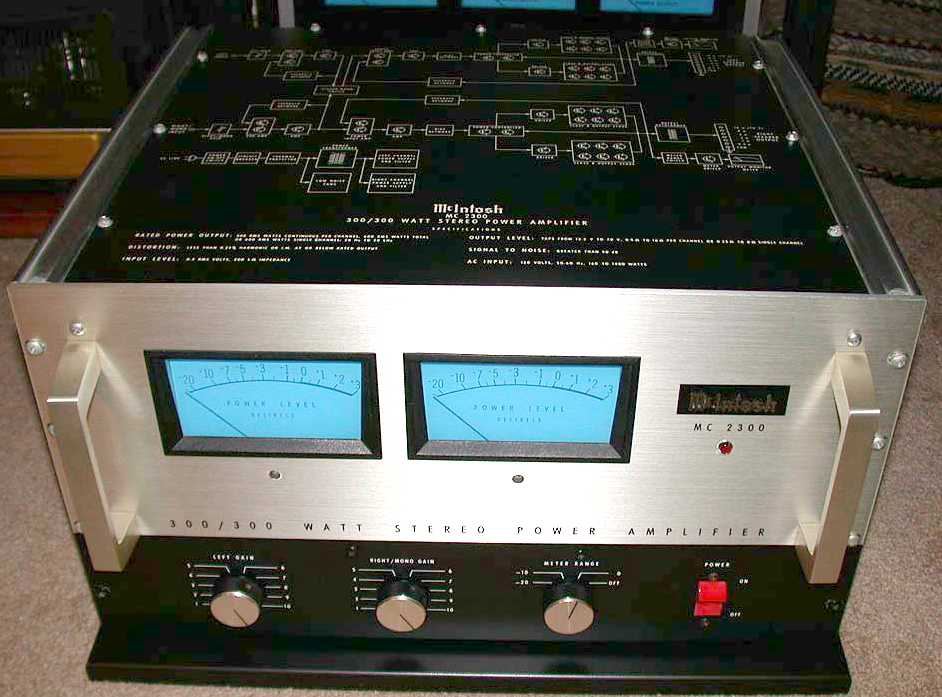
Power is always qualified by load impedance. "150 watts" without a stated impedance is meaningless. Always read it as "150 watts RMS per channel into 8 Ω, both channels driven simultaneously." That last phrase — both channels driven — is important. Some manufacturers rate power with only one channel driven, which can give figures 20–40% higher than real-world stereo operation.
The relationship between power and perceived loudness follows a logarithmic curve. Doubling the power adds only 3 dB of additional SPL — a modest and barely perceptible increase in most rooms. Going from 50 watts to 100 watts is not twice as loud. To produce twice the perceived loudness, you need ten times the power (a 10 dB increase). This is why speaker sensitivity matters so much more than raw amplifier wattage in most real-world situations.
Also note that many amplifiers deliver significantly more power into 4 Ω loads than into 8 Ω. A well-designed amplifier into 4 Ω should deliver approximately double its 8 Ω power, because the lower impedance allows more current to flow. An amplifier that delivers the same power into both 8 Ω and 4 Ω is likely current-limited and will struggle with demanding speakers.
Input Sensitivity — The Gain Matching Spec
Input Sensitivity (mV or V for Full Rated Output)
This is the voltage the amplifier needs at its input terminals to produce full rated power output. A sensitivity of 1 V means you need 1 V RMS from your preamplifier to drive the amplifier to its maximum power. If your preamp can only produce 0.5 V maximum, you can never reach full power. If your preamp produces 4 V and the amp needs only 0.5 V, your volume control will be useful only at very low settings.
Input sensitivity is the primary specification that determines whether a preamp-amplifier pairing will be practical. Mismatched sensitivity is one of the most common causes of systems that are either too loud at the lowest usable volume setting, or that never reach satisfying output levels.
Input Impedance — The Preamp Compatibility Spec
Input Impedance (kΩ)
The input impedance of the power amplifier determines the minimum output impedance the preamplifier can drive without frequency response degradation. Apply the 10:1 rule: preamplifier output impedance should be no more than 1/10th of the amplifier's input impedance. A power amplifier with a 10 kΩ input impedance requires a preamplifier with an output impedance of 1 kΩ or less. Higher input impedance is generally better — it places fewer demands on the preamplifier's output stage.
Damping Factor — Speaker Control
Damping Factor (dimensionless ratio)
Damping factor is the ratio of the speaker's nominal impedance to the amplifier's output impedance. A damping factor of 150 means the amp's output impedance is 1/150th of the speaker's impedance, giving the amplifier strong electrical control over the speaker cone's motion. Low damping factor results in bass that is loose and slow; very high damping factor (above 100) offers diminishing returns in most practical systems.
Peak Current Delivery
Peak Current (Amps per Channel)
The maximum instantaneous current the amplifier can deliver to the speaker load. This determines how well the amplifier controls difficult, low-impedance speakers and reproduces transient musical peaks. A 100 W amplifier with 30 A peak current delivery will sound more dynamic and composed on complex program material than a 100 W amplifier limited to 15 A, particularly with demanding 4 Ω or lower-impedance loads.
Amplifier Signal Path
Reading Distortion and Noise Figures
Distortion and noise specifications are easy to make look good, so the conditions attached to them matter as much as the numbers. For total harmonic distortion (THD) or THD+N, check the power level and frequency range: "0.01% at 1 kHz, 1 W" says far less than "0.05% from 20 Hz to 20 kHz at rated power," because distortion usually rises at high frequencies and near full output.
Signal-to-noise ratio has a similar trap. It is normally quoted relative to the amplifier's full rated output. A 200 W amplifier with an SNR of 110 dB referenced to full power has a noise floor 23 dB closer to a 1 W listening level than that headline suggests. Figures referenced to 1 W are more directly comparable, and they are what matters if you use sensitive speakers, where amplifier hiss can become audible from the listening seat. "A-weighted" figures discount low- and high-frequency noise the ear is less sensitive to, and typically read a few decibels better than unweighted ones.
Bridging, Monoblocks and Multi-Channel Amps
Some stereo power amplifiers can be bridged into a single, more powerful mono channel: one channel drives the speaker's positive terminal and the other an inverted copy to the negative. This doubles the voltage across the speaker and can roughly quadruple the power into the same load — but each channel now effectively sees half the speaker's impedance. Bridging an amplifier into a 4 Ω speaker makes each half work as if driving 2 Ω, which many amplifiers cannot sustain. Most manufacturers recommend bridging into 8 Ω loads only; check the manual before trying it.
Purpose-built monoblocks achieve the same goal differently, with one complete amplifier and power supply per channel. They eliminate shared-supply interaction between channels and can sit close to each speaker, allowing short speaker cables and longer interconnects instead. Multi-channel amplifiers built for home theatre often share one power supply across five or more channels; their rated power per channel is frequently specified with only two channels driven, so all-channels-driven figures are worth looking for.
Heat, Ventilation and Placement
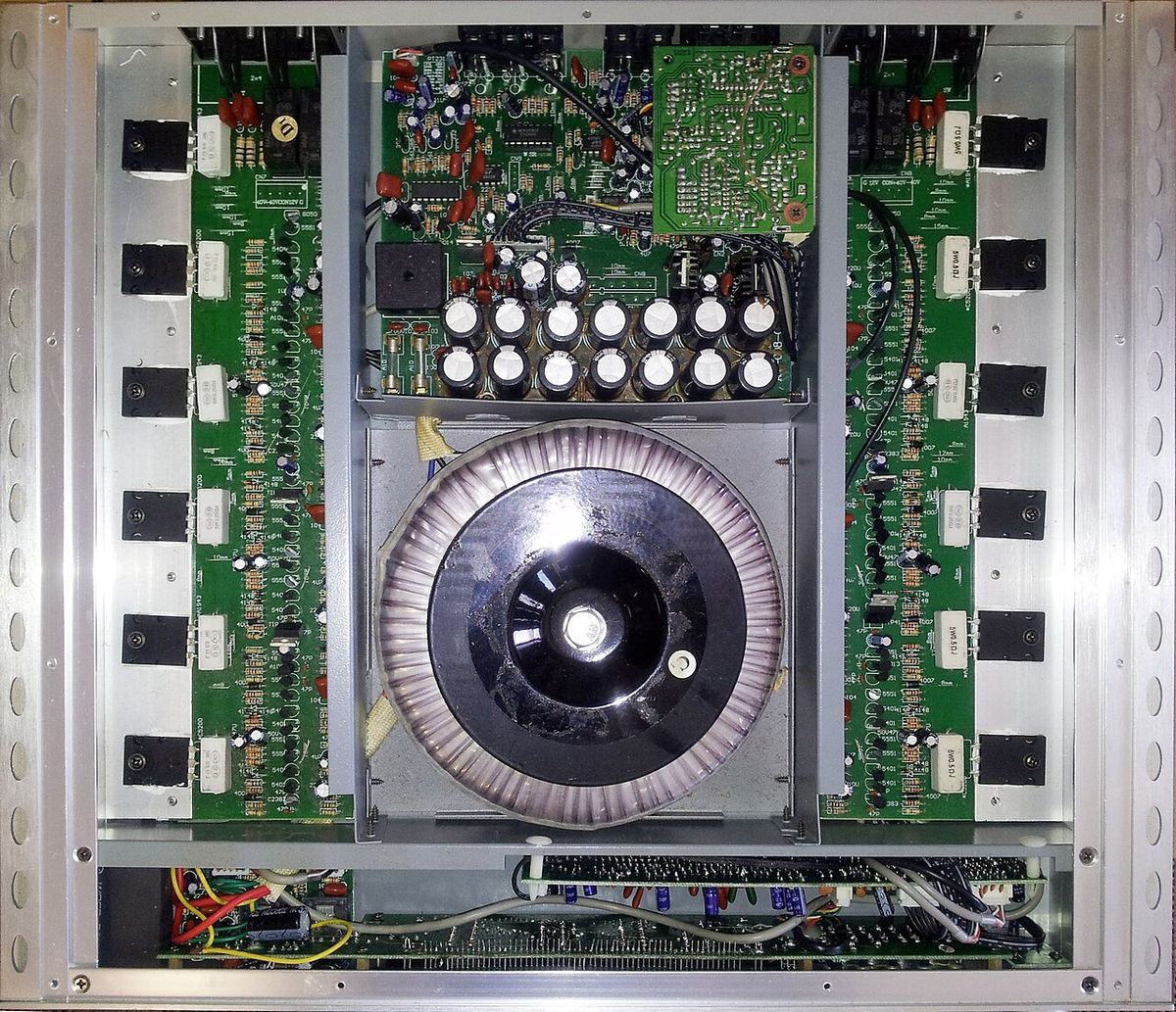
Every amplifier turns part of the power it draws into heat, and heat is what shortens the life of electronic components — especially electrolytic capacitors. Class A designs dissipate most of their consumption as heat even when idle; Class AB designs get warm under load; Class D designs run cool. Whichever you own, leave clear space above and around the heatsinks or ventilation slots, avoid stacking other components directly on top, and do not enclose a hot amplifier in a cabinet without airflow. If the chassis is too hot to keep a hand on comfortably, it needs more ventilation. See the amplifier classes guide for how design affects heat.
Checking a Used Amplifier
Amplifiers are among the best-value used purchases, because a well-made unit can work for decades. A few checks reduce the risk:
- Listen to every input and both channels at low and moderate volume, turning the volume control slowly. Crackles or a channel dropping out usually mean dirty controls or switches, which are often fixable but are a bargaining point.
- Check DC offset. With no input signal and no speakers connected, a multimeter set to DC millivolts across each pair of speaker terminals should read close to zero — typically under 20–30 mV. A large offset can damage woofers and points to a fault.
- Listen for hum and hiss with nothing playing and the volume raised.
- Ask about service history. Amplifiers more than 25–30 years old often benefit from replacement of ageing electrolytic capacitors, which is worth budgeting for.
- Watch the protection relay. Most amplifiers click a relay a few seconds after switch-on to connect the speakers. If it never engages, or drops out during play, the protection circuit has detected a problem.
Before buying, confirm that the amplifier suits your speakers using the amplifier and speaker matching guide.
Quick Reference: Amplifier Specs at a Glance
| Specification | What It Means | What to Look For |
|---|---|---|
| Power Output (RMS) | Continuous power into a stated load | Both channels driven, at your speaker's impedance |
| Input Sensitivity | Voltage needed for full output | Must match your preamp's output voltage |
| Input Impedance | Load presented to the preamp | ≥10× preamp output impedance; higher is better |
| Damping Factor | Amplifier's speaker control | >50 is adequate; >100 is good |
| Peak Current | Instantaneous current capability | Higher = better control of demanding loads |
| THD (full output) | Distortion at maximum power | <0.1% is excellent; specification must be at full output |
| SNR | Noise floor relative to rated output | >95 dB A-weighted is very good |
Check your amplifier's compatibility
Enter your amplifier, speakers, and preamplifier to get a full compatibility analysis including impedance ratios, gain staging, and power headroom.
Run a Free Analysis →