
More Guides
A turntable's job is to rotate a record at a precise, constant speed while a cartridge traces the groove. Every specification flows from that deceptively simple requirement. The specs that affect real-world performance — tonearm mass, platter inertia, and bearing quality — are rarely the ones emphasised in marketing.
Platter: Mass, Material, and Speed Stability
Platter Mass (kg)
A heavier platter stores more rotational kinetic energy, which acts as a mechanical flywheel against speed variations. A 1 kg platter and a 5 kg platter driven by identical motors will behave very differently when the stylus encounters groove modulations — the lighter platter is more susceptible to instantaneous drag pulling at the speed. Meaningful platter mass for a performance turntable starts around 1.5–2 kg; high-end tables commonly use 5–10 kg. The material matters too: acrylic and glass damp resonances differently than aluminium or alloy.
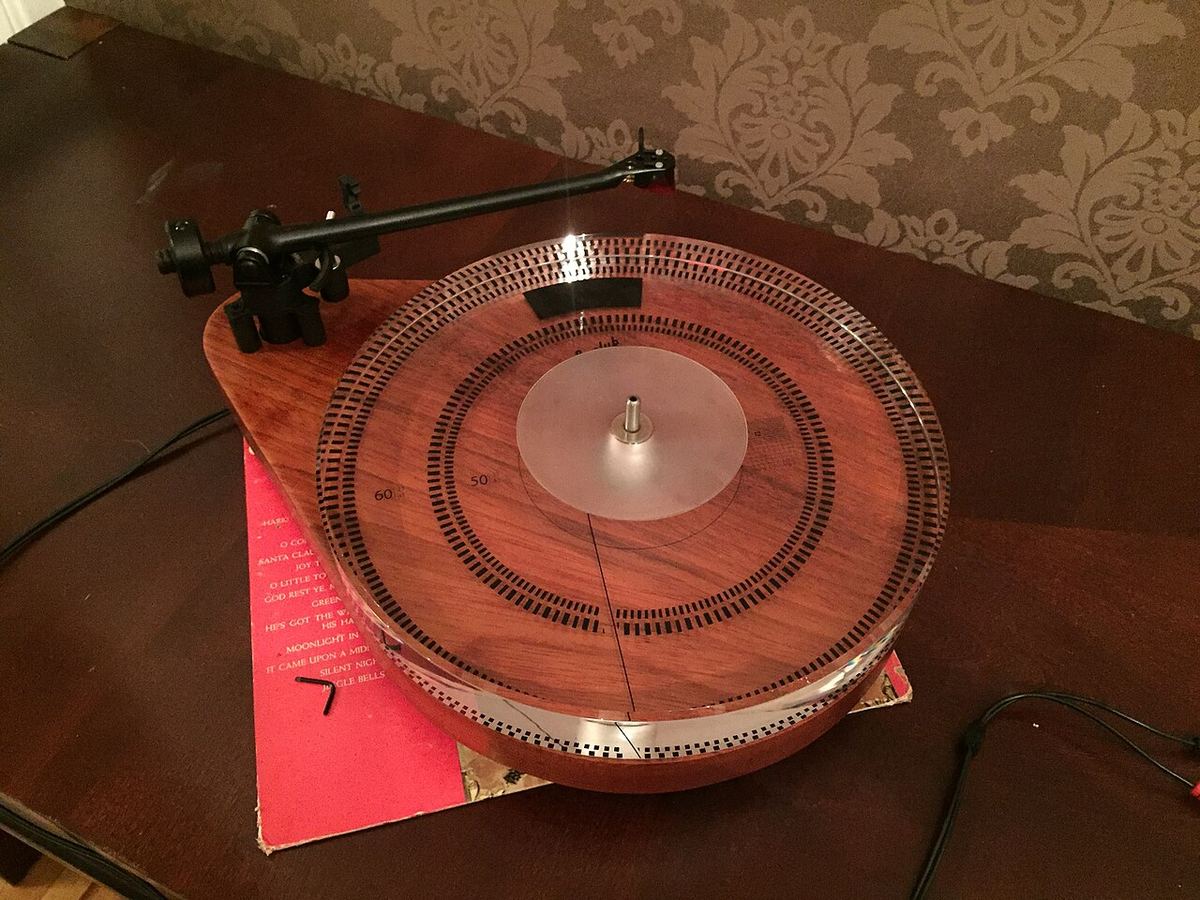
Platter material interacts with record coupling. Acrylic platters sit close to the acoustic impedance of vinyl, which can reduce resonance at the record–platter interface. Some tables use a felt or rubber mat to achieve similar effects with a metal platter. The interaction between record, mat, and platter is subtle but measurable.
Motor Type: Belt, Direct, and Idler Drive
Belt Drive
The motor is isolated from the platter by a rubber or elastic belt. Motor vibration is mechanically decoupled, which typically gives low-frequency noise (rumble) figures. Belt compliance also acts as a filter for motor cogging — the small torque variations inherent in AC or DC motors. The tradeoff is lower rotational inertia in the belt itself and some speed elasticity. High-quality belt-drive tables compensate with a massive platter.
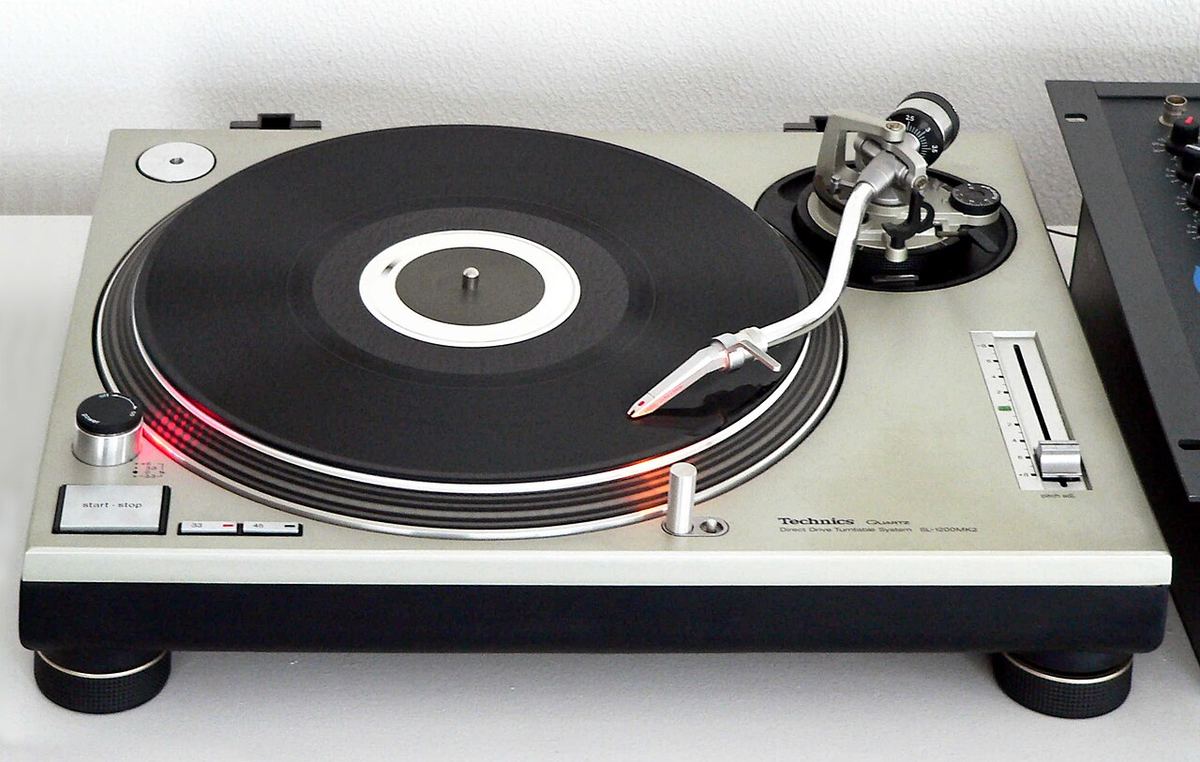
Direct Drive
The motor drives the platter directly, typically via a servo-controlled brushless DC motor. Servo feedback maintains precise speed against drag variations, which matters for DJ use and for tables used with heavy tracking-force cartridges. Modern high-quality direct-drive tables (such as the Technics SP-10 lineage) achieve rumble figures competitive with the best belt-drives. The older reputation for cogging noise applied to 1970s motor technology and is largely obsolete.
Idler Drive
A rubber wheel contacts both the motor spindle and the inner edge of the platter, transmitting drive via friction. Idler-drive tables (Garrard, Lenco) produce very high rotational torque and platter inertia, and have a devoted following for their speed stability under load. Bearing wear in the idler wheel is the primary maintenance concern. Many vintage idler tables benefit significantly from a rebuild of the idler wheel and main bearing.
Wow and Flutter — Reading the Spec Honestly
Wow and Flutter (% weighted RMS)
Wow is slow speed variation (below approximately 6 Hz); flutter is faster variation (6–200 Hz). Both are measured as a percentage of nominal speed and expressed as a weighted RMS figure. A figure of 0.05% or below is excellent and inaudible on most programme material. Figures above 0.1% can be audible as pitch instability on sustained piano or vocals. The weighting function used matters: WRMS (weighted RMS) is the most rigorous standard; peak figures can be 2–3× higher.
Wow and flutter specs are frequently abused. A claim of "<0.05%" may be a peak figure, not WRMS, or measured under laboratory conditions that differ from real-world operation. For a meaningful comparison, the measurement method should be stated. Tables with good bearing quality and adequate platter mass typically achieve low wow and flutter as a consequence — it is a symptom of mechanical quality, not a primary design target.
Signal-to-Noise Ratio (Rumble)
SNR / Rumble (dB, DIN 45539 or IEC 98)
Rumble is low-frequency noise generated by the main bearing and motor, transmitted through the platter to the stylus. It is expressed as a signal-to-noise figure in dB, typically DIN-weighted to match the frequencies of concern. A figure of −70 dB or better is excellent. Below −60 dB, rumble becomes difficult to hear on most programme material. The measurement standard matters: unweighted figures are typically 10–15 dB worse than the DIN-weighted figure, so always check which is being quoted.
Tonearm Effective Mass and Cartridge Compliance
Resonant Frequency: Tonearm Effective Mass + Cartridge Compliance
The tonearm and cartridge form a resonant system. The resonant frequency is determined by the tonearm's effective mass and the cartridge's dynamic compliance. The target resonant frequency is between 8 and 12 Hz — below the audio band (20 Hz) but above the frequencies of record warps (roughly 0.5–5 Hz). The formula is: F = 1000 ÷ (2π × √(M × C)), where M is the total effective moving mass in grams (the arm's effective mass plus the cartridge and its mounting screws) and C is dynamic compliance in 10−6 cm/dyne (µm/mN). A high-compliance cartridge (around 25 × 10−6 cm/dyne) needs a low-mass arm (roughly 8–10 g). A low-compliance MC cartridge (around 8 × 10⁻⁶ cm/dyne) needs a heavier arm (15–25 g).
Compliance mismatch is the single most common cause of poor turntable system performance. A high-compliance cartridge on a heavy arm will have a resonant frequency below 8 Hz — warp energy excites the suspension, causing the cartridge to pump and lose bass control. A low-compliance MC on a lightweight arm resonates above 12 Hz, potentially overlapping the audio band and causing brightness or sibilance problems.
Quick compliance check: Multiply the total moving mass (arm effective mass plus cartridge and screws, in grams) by the cartridge's dynamic compliance (in 10−6 cm/dyne, i.e. µm/mN). The product should be between roughly 175 and 400 for a resonant frequency between 8 and 12 Hz. A product below 175 means the resonance is too high; above 400 means it is too low.
Bearing Quality
The main bearing supports the platter and must spin with minimal friction and zero vertical play. Bearing noise is the primary source of rumble. A well-made bearing uses a hardened steel spindle in a precision-bored brass or bronze housing, lubricated with a specific oil viscosity. Ball-bearing designs and inverted bearing designs (spindle points up, bearing sits in an oil cup) each have adherents. What matters practically is bearing play — there should be none detectable by hand, even after years of use.
Setting Up a New Turntable
Most turntables arrive partly disassembled, and a careful first setup matters more than any later upgrade. A sensible order:
- Choose the location first. A rigid, level surface away from the speakers, ideally not on the same piece of furniture as a subwoofer.
- Level the plinth with a bubble level on the platter, adjusting the feet until it reads level in two directions at right angles.
- Fit the platter and belt as the manual shows. On many belt-drive tables the belt goes around the platter's inner sub-platter and the motor pulley; make sure it is not twisted, and keep skin oil off it.
- Balance the arm and set tracking force, then set anti-skate to match. If the cartridge was not factory-fitted, check its alignment with a protractor. The cartridge setup guide covers each step.
- Connect the ground wire to the phono stage's GND post, and confirm whether the turntable's built-in preamp (if it has one) should be on or off for your amplifier.
- Check speed before you settle in to listen, using one of the methods below.
Checking Speed Accuracy
Wow and flutter describe how much the speed wanders; speed accuracy describes whether the average speed is right in the first place. A table running 1% fast plays every note about 17 cents sharp — a sixth of a semitone, which musicians and people with good pitch memory can notice on familiar recordings. Belt-drive tables in particular drift as belts age and stretch.
There are two easy ways to check. A strobe disc placed on the platter shows a pattern of bars that appears to stand still at the correct speed under mains-powered lighting; many LED lamps do not flicker at mains frequency, so an incandescent bulb or a strobe light designed for the purpose gives a more reliable result. Alternatively, a test record with a steady tone (3,150 Hz is the usual standard) played into a phone speed-measurement app gives a numerical reading of both average speed and wow and flutter. Many tables have a fine-speed adjustment; on others, the fix for a slow table is often simply a new belt.
Isolation and Acoustic Feedback
A cartridge is designed to detect movements of a few micrometres, so it cannot tell the difference between groove modulation and vibration reaching the turntable from outside. Two problems are common. Footfall on a suspended wooden floor travels up through furniture and makes the stylus jump or the sound waver; a wall-mounted shelf, which bypasses the floor entirely, is the most effective fix. Acoustic feedback occurs when sound from the speakers, particularly bass, vibrates the turntable, the cartridge picks it up, and the system amplifies it again. At its worst it becomes a rising howl at high volume; in milder form it simply muddies the bass.
Keep the turntable away from the speakers and especially from a subwoofer, put it on a stiff, stable support, and consider an isolation platform or compliant feet if the table has none. Many listeners also play records with the dust cover open or removed, since a closed lid can act as a sounding board for airborne bass. The stands and isolation guide covers the principles in more depth.
Routine Maintenance
- Stylus: brush it gently from back to front with a small stylus brush before each session — never side to side, which can bend the cantilever.
- Belt: replace every few years, or sooner if speed drifts or the belt looks shiny, cracked or slack.
- Main bearing: follow the manufacturer's lubrication schedule and use the oil they specify; some modern bearings are sealed and need nothing.
- Records: clean records keep the stylus clean, and a clean stylus protects records — see the record cleaning guide.
- Dust: close the lid or cover the platter when the table is not in use.
Buying a Used Turntable
Turntables are mechanical, so their condition can be judged in person with a few simple checks:
- Bearing: with the platter in place, try to rock it gently from side to side. There should be no detectable play, and it should spin freely and quietly by hand.
- Motor: listen with your ear close to the plinth while it runs. A faint hum is normal; grinding or ticking is not.
- Speed: check both speeds with a strobe disc or app, and watch whether the speed holds steady.
- Tonearm: lift it gently and move it through its arc. The bearings should feel free, with no clicking or sideways wobble at the pivot.
- Cueing lift: the arm should lower slowly and smoothly, not drop.
- Stylus: assume a used cartridge's stylus needs replacing unless the seller can show otherwise, and budget for it.
Vintage idler-drive and direct-drive tables can be excellent value, but older ones may need an idler wheel, motor service or new capacitors in the speed-control circuit. The buying used hi-fi guide covers the wider strategy.
Quick Reference: Turntable Specs at a Glance
| Specification | What It Means | What to Look For |
|---|---|---|
| Platter Mass | Rotational flywheel inertia | ≥1.5 kg for a performance table; heavier is better |
| Wow and Flutter | Speed variation, slow and fast | ≤0.05% WRMS; check the measurement method |
| Rumble (SNR) | Bearing and motor noise | −70 dB or better, DIN-weighted |
| Effective Arm Mass | Tonearm inertia at headshell pivot | Must be matched to cartridge compliance |
| Cartridge Compliance | Stylus cantilever stiffness | High-compliance MM: low-mass arm; low-compliance MC: higher-mass arm |
| Resonant Frequency | Arm + cartridge system resonance | 8–12 Hz target range |
| Drive Type | How the motor reaches the platter | Belt, direct, and idler are all viable; quality of execution matters more |
Check your turntable chain compatibility
Enter your turntable, cartridge, phono stage, and amplifier to get a full signal-chain compatibility analysis including gain staging, loading, and impedance ratios.
Run a Free Analysis →