More Guides
A speaker stand looks like furniture and behaves like a component. It sets the height of the drivers relative to your ears, which directly determines tonal balance. It provides — or fails to provide — a rigid reference for a cabinet that is being shaken by its own drivers. And it decides how much of that energy reaches the floor and comes back. None of this is subtle, and stands are among the few purchases in audio where the money is almost always well spent.
Height Comes First
The single most important thing a stand does is put the tweeter at ear level. Most speakers' response above a few kilohertz falls away off-axis vertically, and the crossover region between woofer and tweeter behaves differently at different heights because the two drivers interfere in a pattern that changes with angle. Listen from 30 cm below the tweeter axis and you may lose several decibels of treble and hear a different balance through the crossover region entirely.
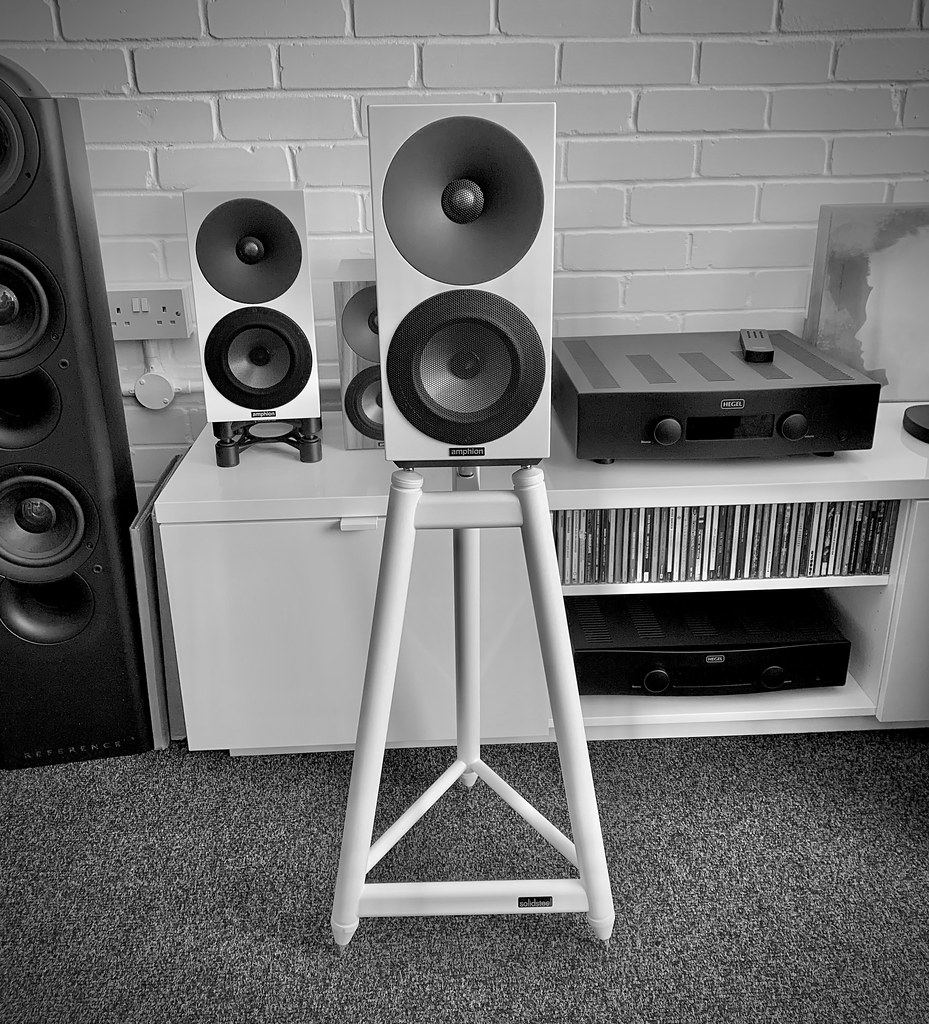
The arithmetic is simple. Seated ear height in a typical listening chair is around 95–110 cm from the floor; in a low sofa it may be 85 cm. Measure the distance from the base of your speaker to the centre of its tweeter, subtract that from your ear height, and the result is the stand height you need. For most standmounts with the tweeter near the top, that lands between 60 and 70 cm — which is why those are the common sizes, and why a 50 cm stand bought because it looked right is usually wrong.
Measure the Chair, Not the Speaker
Sit in your actual listening seat and have someone measure from the floor to the centre of your ear. Then measure your speaker from its base to the tweeter centre. Stand height = ear height − tweeter height. If you fall between available sizes, choose the shorter stand and make up the difference with a slab or thick pad rather than sitting the tweeter above ear level — most speakers tolerate being slightly low better than being high, because the floor bounce is already accounted for in their voicing.
Why Rigidity and Mass Matter
A loudspeaker driver works by pushing air, and by Newton's third law it pushes the cabinet the other way with equal force. A woofer moving several millimetres imparts a real reaction force to the box, and the cabinet will move unless something holds it still. That movement is subtractive: energy that should have gone into the air goes into shaking the enclosure instead, and the cabinet's own motion smears the timing of what you hear.
A stand's job is to be the immovable reference the cabinet pushes against. That requires two things: rigidity, so the stand does not flex; and mass, so that the same reaction force produces less acceleration. A flimsy stand does neither, and the audible result is a vague, thickened lower midrange and bass that lacks definition.
This is why filling hollow stands works. Dry sand, steel shot or a proprietary compound adds mass and, importantly, adds internal damping — a filled column rings far less than an empty one. Fill to just below the top plate, keep it dry, and be aware that a filled pair of stands may weigh 15 kg each and will not be moved casually afterwards.
Coupling vs Decoupling
Here the advice divides, and both camps are right about different floors.
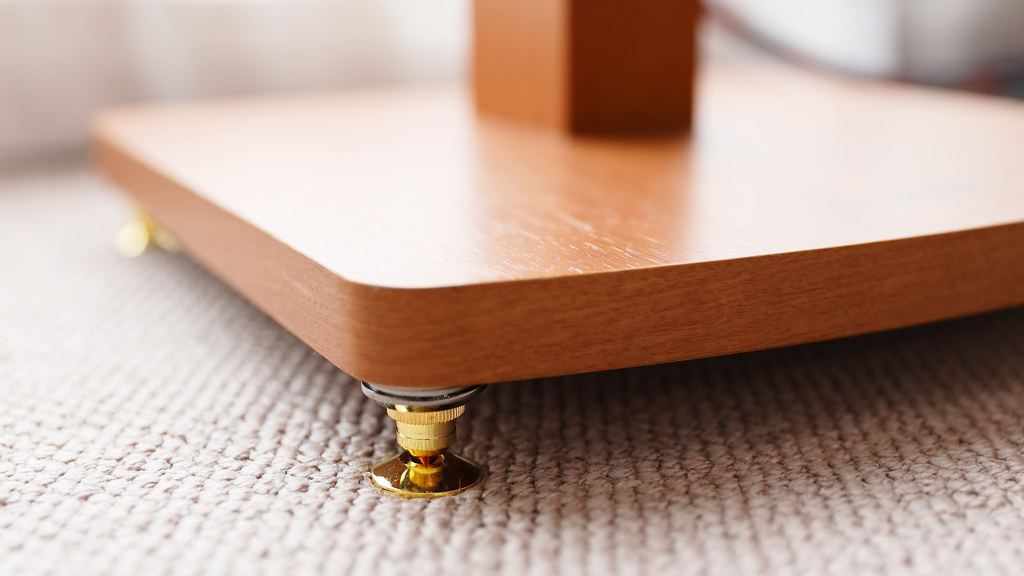
Coupling means connecting the stand firmly to the floor, usually with spikes. On a solid concrete floor this is the correct approach: the spikes penetrate carpet to reach the slab, and the stand and floor become a single very large mass that the speaker cannot move. Coupling gives the cleanest reference and the tightest bass on a solid floor.
Decoupling means deliberately isolating the stand from the floor with a compliant material — rubber, sorbothane, foam, or a sprung platform. On a suspended wooden floor this is often better, because a coupled stand efficiently transmits bass energy into a springy floor that then radiates it back into the room as a slow, boomy resonance. Decoupling reduces that transmission and can transform bass definition in an upstairs room.
The floor decides: concrete or solid ground floor — couple with spikes. Suspended timber floor, especially upstairs — try decoupling with a compliant pad or isolation platform before anything else. This one distinction accounts for most of the disagreement about spikes, and it costs nothing to test both ways.
The speaker-to-stand interface is a separate decision from the stand-to-floor one. Small blobs of self-adhesive putty at the corners of the top plate are the classic solution: they couple the cabinet to the plate, damp the interface, and stop the speaker sliding. Spikes through the top plate into the cabinet base are used by some manufacturers where the speaker is designed for it. Thick soft pads under a standmount are generally a mistake — they let the cabinet rock, which is precisely what the stand exists to prevent.
Floorstanders, Which Are Their Own Stands
A floorstanding speaker has the stand built in, but the same principles apply to its footing. Spikes on a solid floor couple it and, usefully, let you level a cabinet on an uneven surface — important because a rocking floorstander both moves and can buzz. On a suspended floor, the same decoupling logic applies, and isolation feet or a platform frequently tighten the bass noticeably.
Two practical points. First, protect the floor: spike shoes or steel discs prevent damage to timber and let you slide the speaker for placement experiments. Second, level properly with all four feet in firm contact — a speaker resting on three of four spikes is worse than one on a flat base.
Isolation for Source Components
Isolation products are also sold for electronics, and here the honest assessment varies sharply by component.
Turntables genuinely benefit. A record player is a mechanical device reading microscopic modulations with a stylus; airborne and structural vibration reaching the plinth is picked up directly, and on a suspended floor footfalls can literally make the stylus skip. A wall shelf, a proper isolation platform, or a well-designed sprung support solves a real problem. This is not a marginal effect.
Valve equipment benefits modestly. Vacuum tubes are microphonic to a degree — their internal elements can vibrate — so keeping a valve preamplifier away from speaker-borne vibration is reasonable, particularly with high-gain phono stages.
CD players and transports benefit slightly. A spinning disc read by a servo-controlled laser can be disturbed by severe vibration, though modern error correction and buffering handle a great deal.
Solid-state electronics and DACs benefit essentially not at all. There is no mechanism by which normal room vibration affects a DAC chip or a solid-state amplifier's output. Money spent on exotic feet for these is money not spent on stands, placement or room treatment, where it would have done something measurable.
Buying Sensibly
- Get the height right first — it outranks every other consideration, and no amount of mass compensates for a tweeter at chest level.
- Prefer heavy and rigid over decorative. Four-pillar and single-column designs both work; flex and ring do not.
- Fill hollow stands with dry sand or shot, to just below the top plate.
- Match the footing to the floor — spikes on concrete, compliant isolation on suspended timber, and test both if unsure.
- Use putty at the speaker interface unless the manufacturer specifies otherwise.
- Budget properly. Stands deserve a real share of the accessory budget; a good pair costs a fraction of the speakers and makes more difference than most upgrades at that price.
When the Height Cannot Be Right: Tilt
Sometimes the available stands, a room's furniture or the listening seat make it impossible to put the tweeter exactly at ear height. Tilting the speaker so the tweeter axis points at the listener's ears recovers much of the lost treble. The required angle is the arctangent of the height difference divided by the listening distance.
The angles are smaller than intuition suggests. A tweeter 10 cm below ear height at 3 m needs a tilt of about 2 degrees; one 20 cm low at 2.5 m needs about 4.6 degrees. Several manufacturers' stands and some floorstanders build in a small backward rake for exactly this reason. Tilting is a correction for a geometry that cannot be fixed, not an alternative to correct height — it aims the tweeter correctly, but it also changes the reflection from the floor and the timing between drivers, so it is worth checking by ear.
Top Plates, Stability and Safety
A stand's top plate is best sized to the speaker, roughly matching or slightly smaller than the cabinet's base. A top plate that extends well beyond the cabinet provides an extra reflecting surface directly beneath the drivers, and many stand makers size their plates accordingly. Check also that the plate is large enough to support all four corners of the cabinet, since a speaker overhanging a small plate is easier to knock off.
Stability is a genuine safety point. A standmount on a tall, narrow stand is top-heavy, and a heavy speaker falling from 60 cm can injure a child or a pet. Filling the stand lowers its centre of gravity, a wide base helps, and where children or animals are around, fixing the stands to the speakers with putty or the manufacturer's fixings, and the stands to the floor or wall where practical, is sensible.
Desks, Shelves and Furniture
Not every speaker can go on a stand, and the same principles apply wherever a speaker sits.
- Desktop speakers benefit from small angled isolation pads or desk stands. A desk is a large, lightly built panel that resonates readily, so decoupling helps; the angle aims the tweeters up towards the ears and reduces the reflection off the desk surface between speaker and listener.
- Bookshelves enclose a speaker in a cavity that reinforces the bass, often unevenly. Pull the speaker forward so its front baffle is flush with the shelf edge, and fill the space around it with books if the bass booms. A rear-ported design is a poor choice for a shelf; a front-ported or sealed one copes far better.
- Sideboards and media units are often hollow and resonant. A dense slab or a pair of isolation pads between speaker and furniture reduces how much the cabinet excites the furniture, which can otherwise add its own boom.
In each case the priorities are the same as with stands: tweeter at or aimed towards ear height, a firm footing for the cabinet, and as little energy as possible passed into anything that can resonate.
Quick Reference: Stands and Isolation
| Decision | Guidance |
|---|---|
| Stand height | Seated ear height minus base-to-tweeter distance; usually 60–70 cm |
| Construction | Rigid and heavy; fill hollow columns with dry sand or steel shot |
| Solid concrete floor | Couple with spikes through the carpet to the slab |
| Suspended timber floor | Decouple with compliant pads or an isolation platform |
| Speaker-to-stand interface | Blu-tack style putty at the corners; avoid soft pads that let the cabinet rock |
| Turntable support | Worth real money — wall shelf or isolation platform, especially on suspended floors |
| DACs and solid-state electronics | No meaningful benefit from isolation feet |
Get your speakers and room working together
Enter your speakers and room dimensions for a free analysis of placement, bass loading, and how the pairing behaves at your listening position.
Run a Free Analysis →