
More Guides
A subwoofer extends a system’s low-frequency response below what the main speakers can produce and offloads bass demands from the mains, which can reduce distortion in the midrange. The difficulty is never making a sub loud — it is making it disappear, so the bass sounds like it comes from the main speakers rather than from a box in the corner. Integration is a matter of crossover, level, phase, and placement working together.
Crossover Frequency
Low-Pass Crossover Frequency (Hz)
The crossover sets where the subwoofer stops and the mains take over. A common starting point is 80 Hz, which is below the range where the ear can localise bass — keeping the sub acoustically invisible. With small bookshelf mains, you may need to cross higher (100–120 Hz); with large floorstanders, lower (50–60 Hz). Set the crossover roughly where the mains’ in-room response starts rolling off, so the two overlap without a dip or a hump.
Low-Pass Slope (dB/octave)
The slope controls how quickly the sub’s output falls above the crossover. Steeper slopes (24 dB/oct) keep upper-bass localisation cues out of the sub; gentler slopes (12 dB/oct) blend more smoothly with the mains’ natural roll-off but can leave more localisable output. The right slope depends on how the mains roll off — the goal is a flat acoustic sum through the crossover region, not a textbook electrical curve.
Phase and Time Alignment
Phase Control (0–180°) and Polarity
Where the sub and mains overlap, they must arrive in phase or they will partially cancel, producing a suckout exactly in the crossover region. The phase control compensates for the path-length and electrical delay difference between sub and mains. Set it by ear or by measurement: play a tone near the crossover and adjust phase for maximum output, which indicates the two sources are summing constructively. A continuously variable phase control is more useful than a simple 0/180° switch.
Sealed vs Ported Alignment
Sealed (Acoustic Suspension)
A sealed enclosure rolls off gently (12 dB/oct) and has tighter transient response and lower group delay, so it tends to sound faster and more articulate. It trades ultimate extension and efficiency for accuracy. Sealed subs integrate easily with music-focused systems and benefit from room gain to reinforce the bottom octave.
Ported (Bass Reflex)
A ported enclosure uses a tuned port to extend low-frequency output and efficiency, going deeper and louder for a given driver and amplifier. The trade is a steeper roll-off below tuning (24 dB/oct), higher group delay, and the risk of port noise at high output. Ported subs suit home theatre and systems that need maximum extension, where outright low-end weight matters more than the last degree of transient precision.
Placement — The Free Upgrade
Room placement affects a subwoofer’s in-room response more than any other factor, because room modes reinforce and cancel bass depending on where the sub sits relative to the walls. The "subwoofer crawl" finds the best spot empirically: put the sub at your listening position, play bass-heavy material, then crawl around the room’s perimeter and listen for where the bass is smoothest and most even. Place the sub where your ears were. Corners maximise output but often excite room modes unevenly.
Two subs beat one: A pair of subwoofers placed asymmetrically averages out room modes far better than a single sub, producing smoother bass across more seats. If your budget allows, two modest subs usually integrate better than one large one — the improvement is in evenness, not just output.
Connection Method
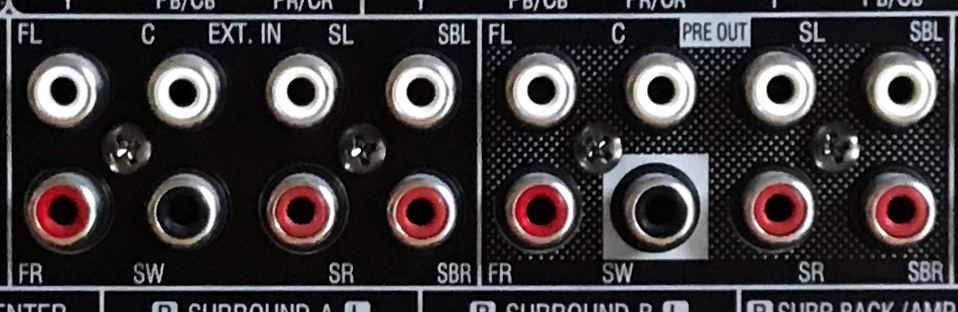
Most subwoofers accept a line-level (RCA/LFE) input from a preamp or processor; many also offer high-level (speaker-level) inputs that tap the amplifier’s output, which can preserve the tonal signature of the main amplifier and is the only option with some integrated amps. For two-channel music with a processor or sub with bass management, a line-level connection with the mains run full-range or high-passed is typical. Whichever you use, set the sub’s internal crossover to bypass if your processor is already handling the crossover, to avoid filtering the signal twice.
Sizing a Subwoofer for Your Room
Subwoofer marketing tends to emphasise driver size and amplifier wattage, but what you need to know is how much clean output the sub produces at the lowest frequencies, and how big a space it has to fill. A larger room, an open-plan layout or a wish for film-level bass all raise the requirement. Rooms that open into other spaces need noticeably more output, because the bass energy spreads into the whole connected volume.
Small rooms work in the subwoofer's favour. Below a frequency set by the room's dimensions, a closed room provides room gain: bass output rises progressively as frequency falls, which complements the gentle roll-off of a sealed sub. In a modest living room, a compact sealed subwoofer can therefore reach lower than its anechoic specification suggests. If independent measurements are available, the most useful figure is maximum clean output at 20 Hz and 30 Hz, which says far more about real capability than driver size does.
Setting the Level
The most common subwoofer mistake is running it too loud. A sub turned up until it is obviously audible is almost always overpowering the rest of the system; when it is set correctly, you mostly notice it when you switch it off and the music suddenly sounds thin. To set it methodically:
- Use an SPL meter or a reputable phone app at the listening seat, with pink noise or a test track.
- Measure one main speaker alone, then the sub alone, and adjust the sub's level until the two read about the same.
- Listen to a range of familiar music and fine-tune by small steps. Many listeners settle a few decibels above flat for film and at or slightly below flat for music.
- Re-check the level whenever you change the crossover frequency or phase, because both affect how much bass reaches the seat.
Measuring the Result
Integration by ear works, but measurement makes it far quicker. Room EQ Wizard (REW) is free software that, together with an inexpensive calibrated USB measurement microphone, shows the in-room frequency response at your seat. With it you can see the crossover region directly, adjust phase or delay until the sub and mains add up without a dip, and identify the room-mode peaks that make bass sound boomy.
If your subwoofer, processor or AV receiver includes parametric EQ, use it to reduce those peaks. Do not try to boost deep nulls: a null is caused by cancellation, and adding power at that frequency mostly produces more cancellation and more strain on the driver. Move the sub or the seat to fix a null instead, as the room acoustics guide explains.
High-Passing the Main Speakers
Adding a subwoofer can also make the main speakers better, if the deepest bass is removed from them. With a high-pass filter on the mains, the main speakers no longer have to produce the lowest octave, which reduces their cone excursion, lowers distortion in the midrange, and lets the amplifier work with more headroom. AV receivers and processors do this automatically through bass management, typically at 80 Hz. In a stereo system, the same result can come from a subwoofer with high-pass outputs, an external DSP crossover, or a preamp with built-in bass management.
Running the mains full-range is the simpler alternative and works well with large speakers that already reach low; the sub then only fills in below their natural roll-off. Whichever you choose, avoid filtering the same signal twice, and make sure only one device is acting as the crossover.
Common Integration Mistakes
- Defaulting to a corner. Corners maximise output but excite every room mode at once; the best position is the one that measures or sounds smoothest at your seat.
- Leaving phase at zero. The right phase setting depends on the distance difference between sub and mains, and it is rarely exactly zero.
- Double crossovers — the sub's own low-pass active on top of a receiver's bass management, which creates a steeper, earlier roll-off and a gap.
- Judging from one seat only. If several people listen, check the bass from each seat; a second sub often helps more than more output.
Quick Reference: Subwoofer Specs at a Glance
| Specification | What It Means | What to Look For |
|---|---|---|
| Crossover Frequency | Handoff point to the mains | ~80 Hz typical; higher for small mains |
| Low-Pass Slope | How fast the sub rolls off on top | Match to mains’ roll-off for a flat sum |
| Phase Control | Aligns sub and mains at crossover | Continuously variable preferred over 0/180° |
| Alignment | Sealed vs ported | Sealed for tight music bass; ported for extension/output |
| Placement | Position in room | Use the crawl method; consider dual subs |
| Connection | How signal reaches the sub | Line-level (LFE) or high-level; avoid double filtering |
Check your subwoofer system compatibility
Enter your speakers, amplifier, and sources to get a full signal-chain analysis. Understand how a subwoofer fits your gain structure and where your mains roll off.
Run a Free Analysis →