
More Guides
A pair of speakers does not have a sound of its own. What you hear is the speakers combined with the room, and the strongest control you have over that combination is where the speakers and your chair sit. Move a speaker eighteen inches and the bass response at your seat can change by more than 10 dB — a difference no component upgrade at any sane price will match. This guide covers what each of the critical distances does, then gives a repeatable routine for finding good positions without measurement equipment.
The Three Distances That Set Everything
Almost all of speaker placement reduces to three measurements, each governing a different part of what you hear.
The distance from the front wall (the wall behind the speakers) primarily controls bass weight and midbass clarity. The distance from the side walls controls early lateral reflections and, with them, the sense of width and image focus. The distance between the speakers and to the listener sets the stereo image — how wide it spreads, whether the centre is solid, and how much of the room you hear versus the speakers.
Change one and you change what you hear in a predictable direction. That predictability is what makes placement a systematic process rather than trial and error.
Boundary Gain and Why the Front Wall Rules Your Bass
At low frequencies, a speaker radiates in all directions. Sound leaving the back of the cabinet reflects off the wall behind and returns to combine with the direct sound. When that reflection arrives roughly in phase, it reinforces — this is boundary gain, and it is why pushing speakers close to a wall makes bass louder. When it arrives out of phase, it cancels, producing a suckout that can remove a whole region of the bass at the listening seat.
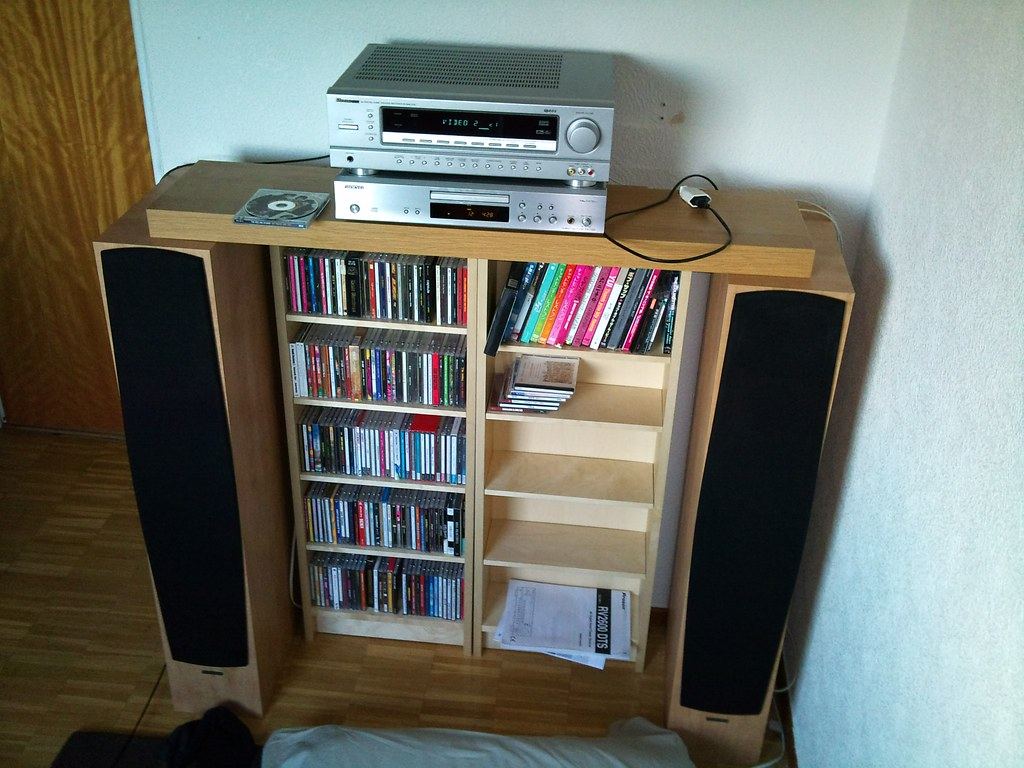
The frequency at which cancellation happens depends directly on the distance: the further from the wall, the lower the cancellation frequency. Very close to the wall (under about 30 cm), the cancellation is pushed high enough to be out of the way and you get reinforcement across the bass, but often at the cost of a thickened, less articulate midbass. Between roughly half a metre and a metre out, the cancellation typically lands in the upper or mid bass and can be very audible. Further still, it moves down towards the region where the room's own modes dominate anyway.
Two Zones That Usually Work
In most rooms, two strategies work and the space between them does not. Either place the speakers close to the front wall (roughly 10–30 cm, best with rear-ported or sealed designs voiced for it), accepting boundary reinforcement and a fuller balance; or pull them well out (typically 0.8–1.5 m from the wall to the driver baffle), which cleans up the midbass and improves depth at the cost of some low-end weight. The awkward middle ground — around 40–70 cm — commonly puts the cancellation right in the upper bass where it is most audible.
Ported speakers need one extra consideration. A rear-firing port close to a wall will be loaded by that wall, usually adding boominess and sometimes port noise. If the speaker must go near the wall and sounds thick, port bungs (or foam) are a legitimate fix — they trade some low-end extension for control.
Side Walls and the First Reflection
Sound reaching your ears from a side wall a few milliseconds after the direct sound smears imaging and can add a hardness to the presentation. The strength of that reflection depends on how close the speaker is to the wall and on the speaker's dispersion.
You have two tools. The first is distance: pulling speakers away from side walls weakens and delays the reflection. The second is absorption at the reflection point, which is where the mirror trick comes in — have someone slide a mirror along the side wall while you sit in the listening position; wherever you can see a tweeter in the mirror is a first reflection point, and that is where a panel goes. The same trick works on the ceiling and, if the floor is hard, tells you where the rug belongs.
Symmetry matters more than absolute distance. A speaker 60 cm from one side wall and 200 cm from the other will pull the image towards the near wall and blur the centre. Where a room forces asymmetry — an opening on one side, a fireplace on the other — treating the reflective side to match the absorptive one recovers much of the balance.
The Listening Triangle and Toe-In
The classic starting arrangement is an equilateral triangle: the distance between the two speakers equals the distance from each speaker to your ears. It is a starting point rather than a rule, but it reliably produces a coherent image, and departures from it have predictable effects.
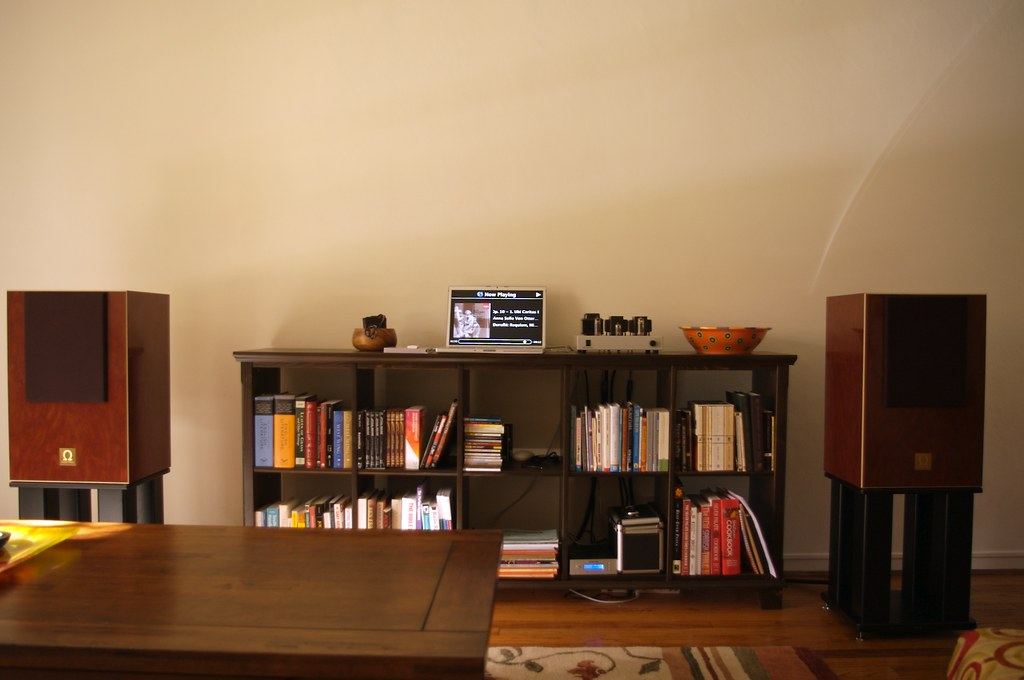
Spreading the speakers wider than the listening distance widens the soundstage but risks a hole in the middle, where instruments seem to come from the speakers rather than from between them. Narrowing them tightens the centre image at the expense of width. As a practical bound, keeping the speaker separation between roughly 0.8 and 1.2 times the listening distance covers most tastes and rooms.
Toe-in — angling the speakers inwards — is the finer control. Firing straight ahead maximises width but can soften the centre and, in a bright room, sends more energy at the side walls. Toeing in so the axes cross just behind your head is a well-tested compromise: it tightens the image, keeps a broad sweet spot, and reduces side-wall energy. Toeing in further, so the axes cross in front of you, gives the most precise central image but the narrowest usable listening area. Adjust in small increments — a couple of degrees is audible.
Height matters more than people expect: the tweeter should sit close to ear height at the listening position, because most speakers' response above a few kilohertz falls away off-axis vertically. This is not a refinement — a tweeter 30 cm below ear level can audibly dull the top end. For standmounts it dictates stand height; for floorstanders it may mean adjusting seat height or using the manufacturer's tilt.
Your Seat Is a Placement Decision Too
The listening position is as acoustically consequential as the speakers, and it is often easier to move. Two rules matter most.
First, avoid sitting hard against the rear wall. Reflections arriving from immediately behind arrive too soon after the direct sound and interfere with it; there is also a strong pressure build-up at the boundary that exaggerates bass. Getting even half a metre of clearance helps noticeably.
Second, avoid the exact centre of the room front to back. The midpoint of a room's length sits at the null of the fundamental length mode — precisely where that frequency is weakest — producing bass that sounds oddly missing at one pitch. A common, well-behaved starting point is to sit at roughly 38% of the room length from the front wall, which avoids the worst nulls of the first few length modes.
A 30-Minute Placement Routine
Placement is best done by ear, in order, changing one thing at a time. Choose three or four familiar tracks — one with a walking bass line that moves through several notes, one with a solo voice, one with a wide mix — and work through these steps.
- 1. Set the seat first. Position your chair around 38% of the room length from the front wall, clear of the rear wall, and centred between the side walls.
- 2. Rough in the triangle. Place the speakers to form an approximate equilateral triangle with the seat, symmetrical about the room centre line, firing straight ahead.
- 3. Set the front-wall distance by ear. Play the bass line and move both speakers together in 10 cm steps. You are listening for even note-to-note level — not the loudest bass, but the bass where no single note booms and none disappears.
- 4. Set the side-wall distance. Adjust separation for the widest image that still holds a solid centre on the vocal track.
- 5. Fix the height. Get tweeters to ear level, seated, with stands or spikes as required.
- 6. Add toe-in last. Start with the axes crossing just behind your head; adjust a couple of degrees at a time until the centre image locks without the sound narrowing.
- 7. Measure and record. Write down every distance once you are happy, so a future experiment can always be undone.
Do not attempt all seven steps in one session with tired ears. The most reliable results come from setting a position, living with it for a few days, and then making one further adjustment.
When the Room Will Not Cooperate
Not every room permits ideal placement. Shared living spaces, doorways, fireplaces and furniture all impose constraints, and the answer is to prioritise rather than give up. Symmetry is the thing to protect hardest: matching what is to the left and right of the speakers matters more than achieving any particular absolute distance. Where a speaker must sit near a wall, choose sealed or front-ported designs, or use port bungs. Where the seat must go against the rear wall, absorption directly behind the head is unusually effective for its cost. And where floorstanders simply cannot be pulled out far enough, standmounts plus a well-placed subwoofer often produce a better result in the same footprint, because the subwoofer can be positioned for the room while the mains are positioned for imaging.
The Front-Wall Cancellation in Numbers
The cancellation frequency can be estimated with a simple formula. The reflection from the wall behind a speaker cancels the direct sound most strongly when its extra path is half a wavelength, which happens at a frequency of roughly 343 ÷ (4 × d), where d is the distance in metres from the woofer's centre to the wall — not from the back of the cabinet.
Worked through for typical distances: 0.3 m gives about 290 Hz; 0.5 m about 170 Hz; 0.7 m about 120 Hz; 1 m about 85 Hz; and 1.5 m about 57 Hz. That explains the two-zone advice. Very close to the wall, the cancellation lands high enough that the woofer is already radiating mostly forward, so the dip is shallow. Well out from the wall, it falls low enough to merge with the room's own modes. In between, it lands squarely in the upper bass, where it is easy to hear.
The same mechanism operates with the side walls and the floor, each with its own distance and its own dip. A useful refinement is to make these distances different from one another. If the woofer is the same distance from the front wall, the side wall and the floor, all three cancellations stack at the same frequency into one deep hole; staggered distances spread them into several shallower dips that are much less audible.
Where Your Room's Modes Fall
The listening-position advice depends on the room's axial modes, which are just as easy to estimate. Along any dimension of length L metres, modes fall at multiples of 343 ÷ (2 × L). In a room 5 m long, the length modes sit at about 34, 69 and 103 Hz. The first has its null at the midpoint, 2.5 m, which is exactly why sitting in the centre of the room sounds thin at that pitch; the 38% position, 1.9 m from the front wall, avoids the strongest nulls of all three.
Width and height modes add their own frequencies — a 4 m width at about 43 Hz, a 2.4 m ceiling at about 71 Hz — and a room where two dimensions produce similar frequencies will have a particularly strong problem there. The Room Acoustics & Mode Calculator works these out for your own dimensions and shows where they cluster.
Measuring Instead of Guessing
The listening routine above works well by ear, but a simple measurement makes the bass decisions much quicker. A calibrated USB measurement microphone and free room-measurement software, such as Room EQ Wizard, will show the frequency response at the listening seat in a few minutes. Peaks and dips in the bass become visible, and the effect of moving a speaker or the seat can be seen directly rather than inferred.
Smartphone sound-level apps are useful for matching the level of two speakers or setting a subwoofer's level, but their microphones are not accurate enough for detailed frequency-response work. Whatever tool is used, measure at the listening position with the seat at ear height, and change one thing at a time between measurements, as with the listening routine.
Quick Reference: What Each Move Changes
| Adjustment | Primary Effect | Typical Starting Point |
|---|---|---|
| Distance from front wall | Bass weight and midbass clarity; sets cancellation frequency | Under 30 cm, or 0.8–1.5 m — avoid the middle |
| Distance from side walls | Strength of first reflections; image focus and width | As far as symmetry allows; treat the reflection points |
| Speaker separation | Soundstage width vs centre-image solidity | 0.8–1.2 × the listening distance |
| Toe-in | Image precision, sweet-spot width, side-wall energy | Axes crossing just behind the head |
| Tweeter height | Treble level and tonal balance at the seat | Level with seated ear height |
| Seat position | Which room modes you sit in; rear-wall reflection | ~38% of room length; clear of the rear wall |
Check your room and speaker match
Enter your speakers and room dimensions for a free analysis of how the pairing behaves — bass loading, likely problem frequencies, and placement guidance.
Run a Free Analysis →