
More Guides
Tubes and transistors both amplify, but they do so with different transfer characteristics and, crucially, different output stages. A solid-state amp usually drives the speaker directly from low-impedance transistors; most tube amps use an output transformer to match the high-impedance tube stage to a low-impedance speaker. That transformer, and the resulting output impedance, accounts for most of the audible differences people attribute to "tube sound."
Output Impedance and Damping Factor
Output Impedance / Damping Factor
Damping factor is the ratio of the speaker impedance to the amplifier’s output impedance — it describes how tightly the amp controls the driver’s motion. Solid-state amps typically have very low output impedance (high damping factor, 100–500+), gripping the woofer firmly for tight bass. Tube amps, through their output transformers, have higher output impedance (damping factor often 2–20). The consequence: a tube amp’s frequency response varies with the speaker’s impedance curve, subtly shaping tonal balance — sometimes flattering, sometimes loose in the bass. For the numbers behind this, see the damping factor guide.
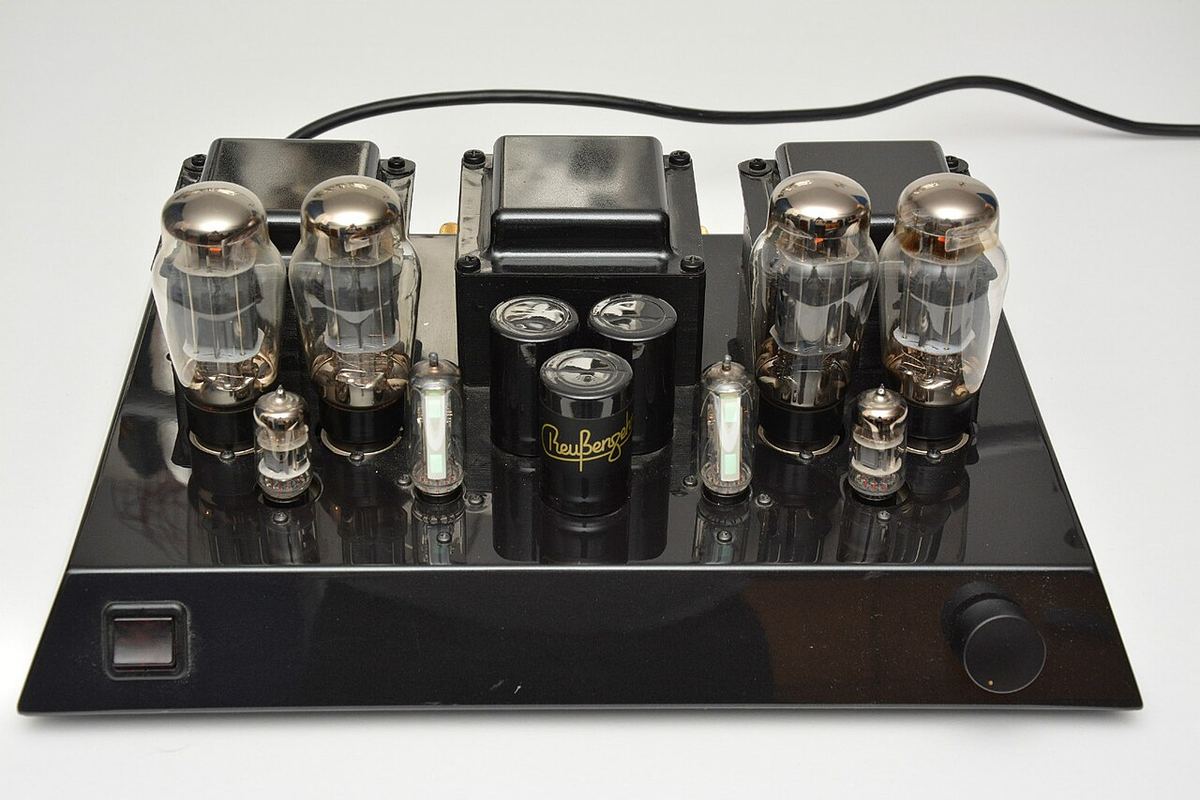
Because a tube amp’s output interacts with the speaker’s impedance curve, the same amp can sound different on different speakers. A speaker with a wildly varying impedance curve will have its frequency response altered by a high-output-impedance tube amp; a speaker with a flat impedance curve is far less affected. This is why tube amps and speakers are often recommended as matched pairs.
Distortion Profile
Harmonic Distortion Spectrum
Total harmonic distortion (THD) figures alone hide the important detail: which harmonics. Tube amps, especially single-ended designs, tend to produce predominantly low-order, even-harmonic distortion (2nd, 4th), which the ear perceives as warm or pleasant and which masks higher harmonics. Solid-state amps usually measure far lower THD overall but can produce more odd-order (3rd, 5th, 7th) harmonics near clipping, which sound harsher. The numbers favour solid-state; the subjective character is why some listeners prefer tubes.
Operating Class
Class A
The output devices conduct over the full signal cycle. Class A is the most linear and lowest-distortion mode, used in many single-ended tube amps and premium solid-state designs. The cost is efficiency — Class A runs hot and wastes most of its power as heat, so output powers are modest (often a few watts to ~30 W). It demands efficient speakers.
Class AB / Push-Pull
Two devices (or banks) each handle half the waveform, handing over near the zero crossing. Class AB is far more efficient than Class A and delivers high power, which is why most amplifiers — tube push-pull and solid-state alike — use it. The design challenge is managing crossover distortion at the handover point; good biasing minimises it. Push-pull tube amps trade some of the single-ended even-harmonic "magic" for much higher power and lower distortion.
Power, Sensitivity, and Speaker Matching
Tube amplifiers generally make less power than comparably priced solid-state amps, so speaker sensitivity matters more. A 300B single-ended triode making 8 watts needs a high-sensitivity speaker (95 dB/W/m or more) to play at realistic levels; pairing it with a 84 dB bookshelf speaker that dips to 3 ohms will disappoint. Solid-state amps with abundant current handle low-impedance, low-sensitivity speakers more easily. Match the amplifier’s power and current delivery to the speaker’s sensitivity and impedance, regardless of technology.
Maintenance reality: Tubes wear out. Output tubes last roughly 2,000–5,000 hours and need periodic bias adjustment (unless auto-biasing); small-signal tubes last longer. Budget for replacement tubes and, on fixed-bias amps, occasional bias checks. Solid-state amps are essentially maintenance-free by comparison.
Triode, Pentode and Ultralinear
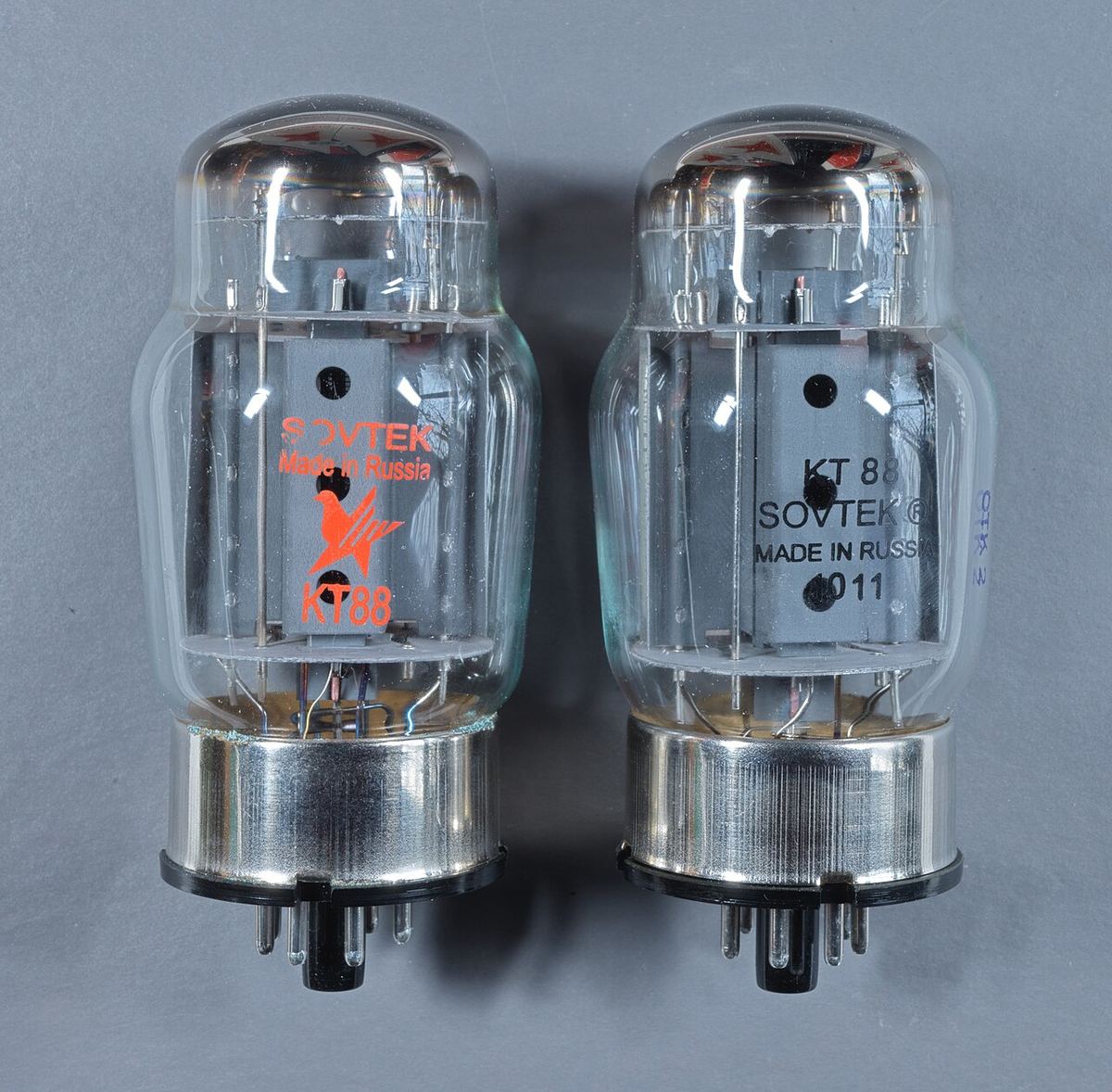
Not all tube output stages behave the same way, and the configuration explains a lot about how an individual tube amp will sound and how much power it makes. A triode output stage has the lowest output impedance and the most benign distortion of the three, but makes the least power. A pentode or beam tetrode (the EL34, KT88 and 6L6 families) makes considerably more power from the same tube, but has a much higher output impedance unless the designer applies plenty of negative feedback.
Ultralinear operation, popularised in the early 1950s, is the compromise used in a great many push-pull amplifiers: the tube's screen grid is connected to a tap partway along the output transformer winding, giving most of the pentode's power with a good share of the triode's linearity. Some amplifiers include a switch to choose between ultralinear and triode modes. Expect power to drop by roughly half in triode mode, with slightly lower output impedance and a sound many listeners describe as more relaxed.
Negative Feedback and Output Taps
Negative feedback — returning a portion of the output to the input in inverted form — lowers distortion and output impedance in any amplifier. Tube designs vary enormously in how much they use. A zero-feedback single-ended triode amplifier can have an output impedance of several ohms, a damping factor near 1–3, and a frequency response that visibly follows the speaker's impedance curve. A push-pull amp with moderate feedback may come in under 1 Ω, and behave much more like a solid-state design. When comparing tube amps, the feedback approach and the measured output impedance tell you more than the power rating does.
Most tube amplifiers also provide separate speaker terminals labelled 4, 8 and sometimes 16 Ω. These connect to different taps on the output transformer, so the tube stage sees the load it was designed for. Start with the tap that matches your speaker's nominal impedance. Because many speakers marked 8 Ω spend much of their range nearer 4–6 Ω, it is worth trying the next tap down as well: the lower tap usually gives a slightly lower output impedance and tighter bass, sometimes at the cost of a little maximum power. There is no risk in experimenting between taps, as long as the amplifier is switched off while you move the cables.
Hybrids and Tube Preamplifiers
If you want some of the tube character without the power limitations, there are two common middle paths. A tube preamplifier driving a solid-state power amplifier keeps the low-maintenance, high-current output stage while putting tubes in the low-level signal path. Small-signal tubes last far longer than output tubes, so running costs are modest. The one thing to check is the preamp's output impedance, which can be in the region of 1–2 kΩ on some designs; the power amplifier's input impedance should be at least ten times higher, and long interconnect runs are best avoided because cable capacitance combined with a high source impedance can roll off the treble.
A hybrid integrated amplifier does the same thing inside one chassis: tubes in the input or driver stage, transistors (often MOSFETs) at the output. Hybrids generally have solid-state output impedance and power, so they drive ordinary speakers without the careful matching a pure tube amp needs.
Living With a Tube Amplifier
Tube amplifiers reward a little care and punish a few specific mistakes:
- Never run it without a load. Many tube amplifiers can be damaged if driven with no speakers connected, because the output transformer's voltage can rise high enough to arc. Always connect speakers before switching on, and never disconnect them while it is playing.
- Give it air. Output tubes run hot enough to burn skin and to damage cabinets above them. Keep the top clear, and use the tube cage around children and pets.
- Allow warm-up. Tubes need a short time to reach operating temperature, and many amps sound best after fifteen to thirty minutes.
- Watch for warning signs. A tube whose metal plate begins glowing red ("red-plating") is drawing far too much current: switch off immediately and check the bias or replace the tube. A silvery getter patch at the top of a tube turning milky white means air has got in and the tube is finished. New crackles, rushing noise, or ringing when you tap the chassis usually point to one failing tube.
- Replace output tubes in matched pairs or quads in push-pull amps, and re-check bias afterwards unless the amp biases itself.
Quick Reference: Tube vs Solid-State
| Characteristic | Tube | Solid-State |
|---|---|---|
| Output Impedance | Higher (low damping factor) | Low (high damping factor) |
| Bass Control | Looser, speaker-dependent | Tighter, consistent |
| Distortion | Higher THD, mostly even-order | Lower THD, more odd-order near clipping |
| Power | Generally lower | Generally higher, more current |
| Speaker Matching | Needs efficient, flat-impedance speakers | Drives difficult loads more easily |
| Maintenance | Tube replacement, bias adjustment | Essentially maintenance-free |
Match your amplifier to your speakers
Enter your amplifier and speakers to get a full compatibility analysis including power adequacy, sensitivity matching, and impedance behaviour — for tube or solid-state.
Run a Free Analysis →