
More Guides
Of the three parts of a record player — deck, arm and cartridge — the tonearm attracts the least attention and constrains the most. A cartridge can be swapped in an afternoon; the arm decides which cartridges are worth swapping to. Its job is a contradiction: hold the cartridge rigidly enough that only the stylus moves, while offering so little resistance that the stylus can follow groove modulations weighing fractions of a gram. Everything in tonearm design is an attempt to resolve that contradiction, and the specifications follow from it.
Effective Mass: The Number That Decides Compatibility
Effective mass is the inertia the stylus sees when it tries to move the arm, expressed in grams and measured at the stylus tip. It is not the arm's weight — a heavy counterweight close to the pivot contributes very little, while a modest increase in headshell mass at the far end contributes a great deal, because inertia scales with the square of the distance from the pivot.
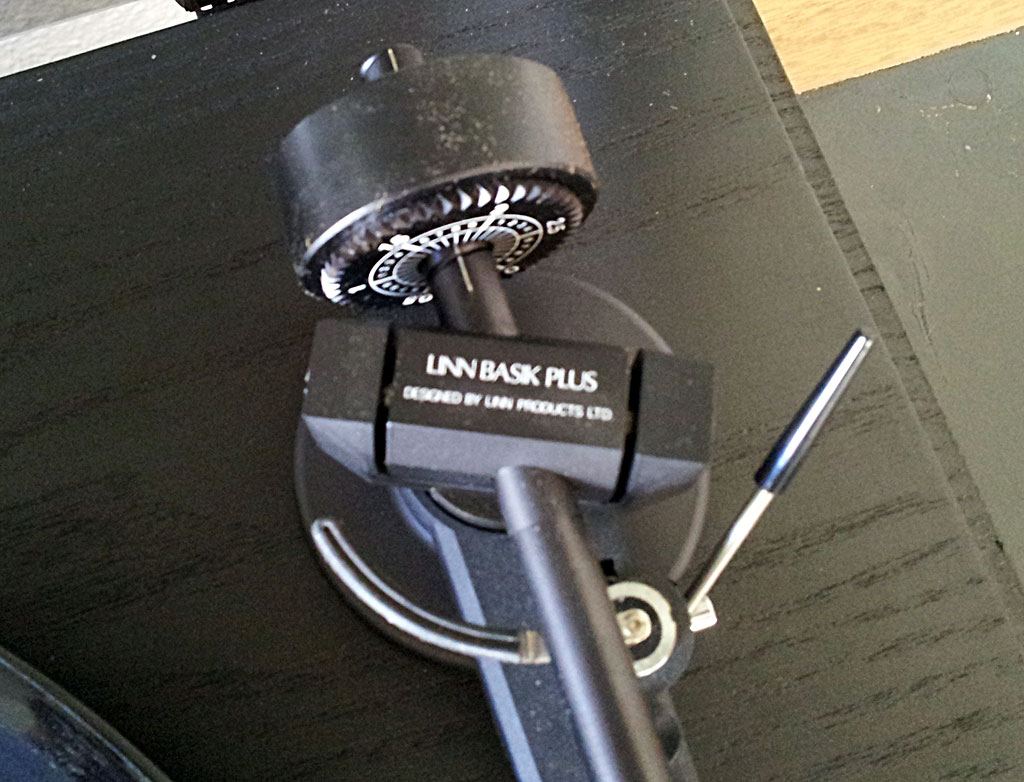
Arms are usually grouped into three ranges. Low mass is roughly under 10 g, medium mass around 10–18 g, and high mass above about 18 g. Most modern arms sit in the medium band, which is the most broadly compatible place to be.
The reason the number matters is that the arm and cartridge together form a spring-mass system. The cartridge's suspension is the spring; the arm's effective mass plus the cartridge's own mass is the mass. Like any such system it has a resonant frequency, and where that frequency falls determines whether the combination works.
Landing the Resonance Between 8 and 12 Hz
The mass-compliance resonance should sit in a window between roughly 8 and 12 Hz. Above about 15 Hz it starts to intrude on the lowest musical content, colouring the bass. Below about 7 Hz it falls into the region of warped records, footfalls and turntable rumble, where it will be excited constantly — producing visible cone flapping and audible instability. The resonant frequency falls as either effective mass or compliance rises, which gives the pairing rule: high-compliance cartridges need low-mass arms, and low-compliance cartridges need high-mass arms.
The calculation itself is straightforward. Add the cartridge mass and any headshell screws to the arm's effective mass to get the total moving mass, then combine that with the cartridge's dynamic compliance at 10 Hz. A cartridge of 8 g and compliance around 10 µm/mN wants a heavy arm; a 5 g cartridge with compliance of 25 wants a light one. Note the frequency at which compliance is quoted — some manufacturers publish figures at 100 Hz, which run lower than the 10 Hz figure the calculation needs, and mixing the two produces nonsense.
Bearings: Where Rigidity and Freedom Compete
The bearing is the arm's pivot, and its quality sets the floor for everything else. It must permit motion in two axes with essentially no friction while allowing no play in any other direction. Those goals conflict, and different designs weigh them differently.
Gimballed bearings use two sets of pivots at right angles, usually with precision ball races, giving independent and well-controlled motion in both planes. They are the most common design, they are rigid in the directions that matter, and their quality is set by the tolerance of the races: play in a gimbal bearing is audible as smeared images and vague bass.
Unipivot arms balance the whole armtube on a single point, usually a hardened tip in a cup. Friction is extremely low and the design is elegant, but the arm is free to rotate about its long axis, which makes azimuth adjustment both possible and necessary. Unipivots often feel wobbly in the hand and behave perfectly in the groove; the trade is more setup sensitivity for less bearing friction.
Knife-edge bearings support the vertical axis on a hardened edge resting in a trough, giving very low friction with more lateral stability than a unipivot. Less common now but used on some highly regarded arms.
Geometry: Effective Length, Overhang and Offset
A pivoted arm swings through an arc while the cutting lathe that made the record moved in a straight line. That mismatch cannot be eliminated, only minimised, and tonearm geometry is the art of minimising it.
Three quantities describe the arrangement. Effective length is the distance from the pivot to the stylus. Overhang is how far the stylus extends past the spindle when swung across it. Offset angle is the angle by which the cartridge is turned in the headshell. Together they determine the two points across the record where the stylus is exactly tangential to the groove — the null points — and how much tracking error remains everywhere else.
Longer arms reduce the residual error because they trace a flatter arc: a 12-inch arm has meaningfully lower maximum tracking error than a 9-inch one. The offsetting cost is higher effective mass, since the extra length adds inertia, and greater sensitivity to bearing quality because errors are amplified over the longer tube. Nine to ten inches remains the practical mainstream; twelve-inch arms suit heavier, low-compliance cartridges where the extra mass is welcome anyway.
Alignment geometry is a choice, not a constant. Baerwald, Löfgren B and Stevenson are three standard alignments, and they place the null points differently — Baerwald minimises average distortion across the side, Stevenson pushes a null point right to the inner groove where tracking is hardest. Use the alignment your arm's manufacturer specifies, since overhang and offset are designed together, and use a protractor built for that geometry.
Linear Tracking and Other Approaches
Linear tracking arms sidestep the geometry problem entirely by moving the cartridge in a straight line across the record, exactly as the lathe did. Tracking error falls to essentially zero and there is no skating force to compensate for. The engineering cost is significant: the carriage must move with very low friction and be driven or allowed to advance smoothly, and air-bearing designs need a pump. They are superb when properly implemented and demanding to keep that way.
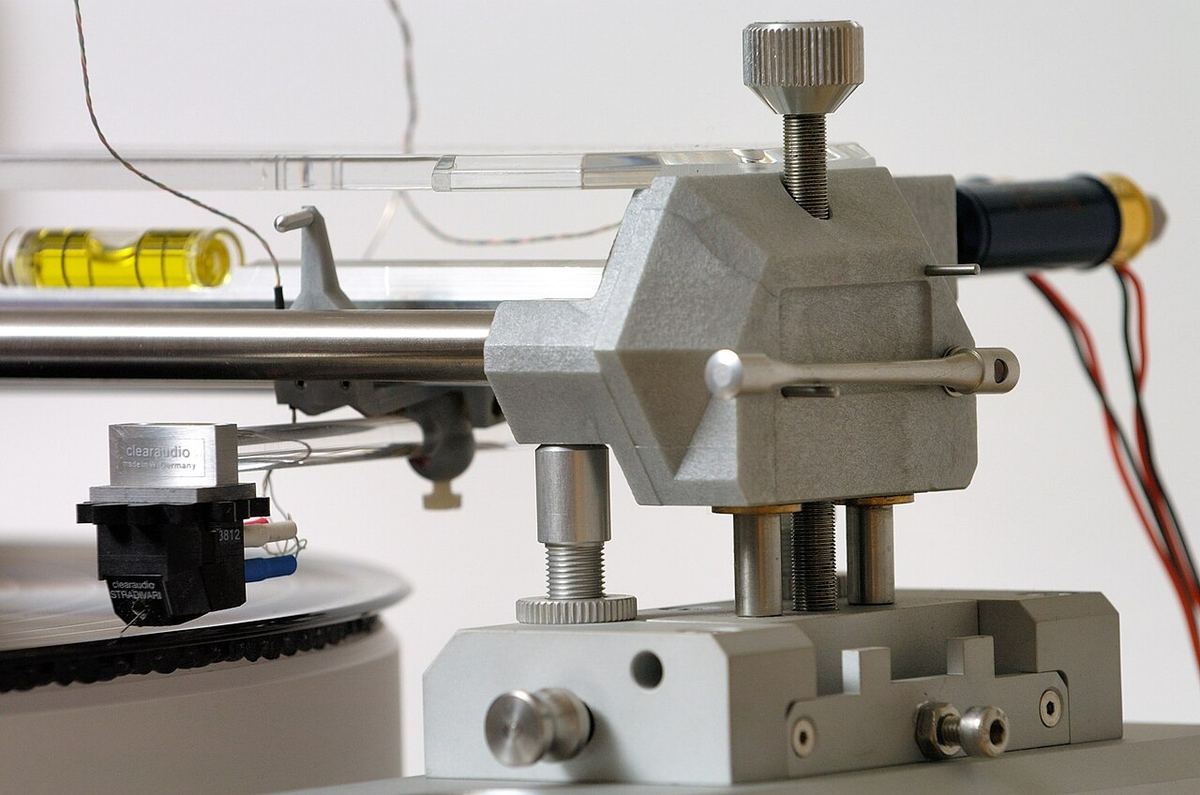
Two other variables are worth knowing. Armtube material — aluminium, carbon fibre, wood, magnesium — is a balance between stiffness, mass and internal damping; there is no single best answer, and a well-damped moderate material often beats a stiffer but more resonant one. Adjustability matters more than any material claim: an arm that lets you set VTA, azimuth and overhang precisely will outperform a theoretically superior arm you cannot set up correctly.
Anti-Skate and the Sideways Force
Because a pivoted arm holds the cartridge at an offset angle, friction between stylus and groove produces a net force pulling the arm towards the record's centre. Left uncorrected, this skating force presses the stylus harder against the inner groove wall than the outer, producing channel imbalance, uneven wear and mistracking that usually shows up on the right channel first.
Anti-skate applies a counterforce, by spring, magnet or hanging weight and thread. Thread-and-weight mechanisms are the most transparent to set and the least prone to drift; spring mechanisms are convenient and can lose calibration over years. The correct amount is roughly proportional to tracking force but varies with stylus profile and groove modulation, so the dial marking is a starting point rather than a setting — a test record, or careful listening for the balance point between channels on heavily modulated inner grooves, gets you closer.
Choosing an Arm, or Choosing Around One
Most people do not buy a tonearm in isolation; they buy a turntable with an arm fitted, and then choose cartridges to suit. That order is fine, provided the arm's effective mass is known and used as a filter.
- Find the effective mass first. It is published for almost every arm; without it you cannot predict compatibility.
- Filter cartridges by the resonance calculation before considering anything else about them. A cartridge that lands the pair outside 8–12 Hz is the wrong cartridge, however good it is.
- Check the bearings by feel. With the counterweight off, the arm should move freely in both planes with no perceptible play or grittiness.
- Prefer adjustability. VTA on the fly, azimuth adjustment and a proper anti-skate mechanism are worth more in practice than exotic materials.
- Spend on the arm before the cartridge. A good arm will support progressively better cartridges for years; a poor one caps every cartridge you fit to it.
A Worked Resonance Example
The calculation is short enough to do by hand. With total moving mass M in grams and compliance C at 10 Hz in µm/mN (numerically the same as 10−6 cm/dyne), the resonant frequency is approximately 159 ÷ √(M × C).
Take a medium-mass arm of 12 g, a 6.5 g cartridge and 1 g of mounting hardware: a total of 19.5 g. With a cartridge compliance of 15, the resonance is 159 ÷ √292.5, or about 9.3 Hz — comfortably in the window. Fit a high-compliance cartridge of 25 to the same arm and the result falls to about 7.2 Hz, low enough to be excited by warps. Move that cartridge to an 8 g arm and the total falls to 15.5 g, bringing the resonance back up to about 8.1 Hz. A low-compliance moving-coil cartridge of 10, weighing 9 g, on the 12 g arm lands at about 10.7 Hz.
Where only a 100 Hz compliance figure is published, a conversion factor of about 1.7 is a common approximation for estimating the 10 Hz value. It is a rule of thumb rather than a law, so a result near the edges of the window deserves a check by measurement. The AudioChainHiFi analyzer performs this calculation automatically when it has the arm's effective mass and the cartridge's mass and compliance.
Checking the Resonance in Practice
Several test records include a low-frequency band that sweeps slowly through roughly the 5–15 Hz range, often with separate lateral and vertical tracks. Play it and watch the arm: at resonance, the headshell visibly shakes or wobbles, and the frequency at which that happens can be read from the record's announcements or markings. Lateral and vertical resonances are often slightly different, because the arm's mass is distributed differently in each plane.
A related warning sign needs no test record at all. If a woofer cone visibly pumps in and out while a slightly warped record plays, with no music at that frequency, the arm and cartridge resonance is being excited, and the combination is probably resonating too low.
Adjusting a Combination That Misses
A pairing that lands slightly outside the window can often be corrected rather than abandoned. Adding mass at the headshell — a heavier headshell, or small weights designed for the purpose — lowers the resonance, which helps when a low-compliance cartridge on a light arm resonates too high. Remember that added mass at the headshell must be rebalanced with the counterweight, and some arms offer a heavier counterweight for heavy cartridges.
Raising the resonance is harder, since mass can rarely be removed. A lighter headshell or lighter mounting screws help a little. Some arms offer fluid damping, in which a paddle sits in a trough of silicone fluid; it does not move the resonance, but it reduces the height of the resonant peak, which makes a marginal pairing better behaved on warped records. Use it sparingly, since too much damping can dull the sound.
Removable Headshells
Many arms use a detachable headshell on a standard bayonet fitting, which makes it easy to keep several cartridges mounted and aligned and swap them in seconds. The trade-offs are an extra mechanical joint, which must be tight to avoid rattle, and the headshell's own mass, which forms a large part of the arm's effective mass. When a manufacturer's effective-mass figure is quoted with or without the headshell, check which before doing the resonance calculation, since a 10–15 g headshell changes the answer substantially.
Quick Reference: Tonearm Specifications
| Specification | Typical Range | What It Governs |
|---|---|---|
| Effective mass | 5–25 g | Which cartridge compliances will work; the resonant frequency |
| Mass-compliance resonance | Target 8–12 Hz | Stability against warps and rumble without colouring the bass |
| Effective length | 9–12 in | Residual tracking error; longer arms track flatter but weigh more |
| Overhang | ~15–19 mm | Where the null points fall; set with the correct protractor |
| Offset angle | ~20–24° | Tangency across the arc; also the cause of skating force |
| Bearing type | Gimbal, unipivot, knife-edge | Friction versus rigidity; unipivots need azimuth setting |
Check your tonearm and cartridge match
Enter your turntable, tonearm and cartridge for a free analysis of the mass-compliance resonance, loading, and gain through the rest of the chain.
Run a Free Analysis →