
More Guides
Ask what a preamplifier does and the usual answer is "it selects a source and sets the volume" — both true, and both a poor description of why the component exists. A preamplifier is an impedance and gain manager. It presents a load that sources are happy driving, it drives cables and power amplifier inputs that sources often cannot, and it sets the signal level so that the power amplifier operates in its comfortable range. Get those three things right and the preamplifier disappears; get them wrong and no amount of quality elsewhere compensates.
The Job, Properly Stated
Four functions live in a preamplifier, in rough order of how much they affect the sound.
Impedance buffering. A source has an output impedance; a power amplifier has an input impedance; a cable between them has capacitance. If a source with a high output impedance drives a low input impedance directly, the signal is attenuated and the high frequencies roll off. The preamplifier sits between them presenting a high impedance to the source and a low impedance to the amplifier, so neither has to cope with the other.
Gain and attenuation. Modern line-level sources produce around 2 V, and most power amplifiers reach full output on 1–2 V. So in most systems the preamplifier's net job is to reduce level, not increase it. Where gain is genuinely needed is with low-output sources — tape heads, some tuners, older equipment — and with insensitive power amplifiers.
Source selection. Switching between inputs cleanly, without crosstalk from the unselected sources bleeding into the active one.
Cable driving. A low output impedance lets the preamplifier drive long interconnects and capacitive loads without losing treble — the practical reason a preamplifier helps in systems where the power amplifiers sit near the speakers.
Impedance Matching in One Line
The receiving component's input impedance should be at least ten times the sending component's output impedance. A source with 100 Ω output into a preamplifier with 47 kΩ input is comfortable by a huge margin. A valve preamplifier with 5 kΩ output impedance into a power amplifier with 10 kΩ input is not — the ratio is 2:1, and you will lose level and, because output impedance rises at low frequencies in transformer- and capacitor-coupled designs, lose bass with it. This single check catches most real-world preamp-to-power-amp mismatches.
Active vs Passive
An active preamplifier contains gain stages: the signal passes through amplification, and the volume control sets how much of the amplified signal reaches the output. It can supply gain when needed, and it presents a low output impedance regardless of where the volume control sits, so it drives cables and amplifier inputs reliably.
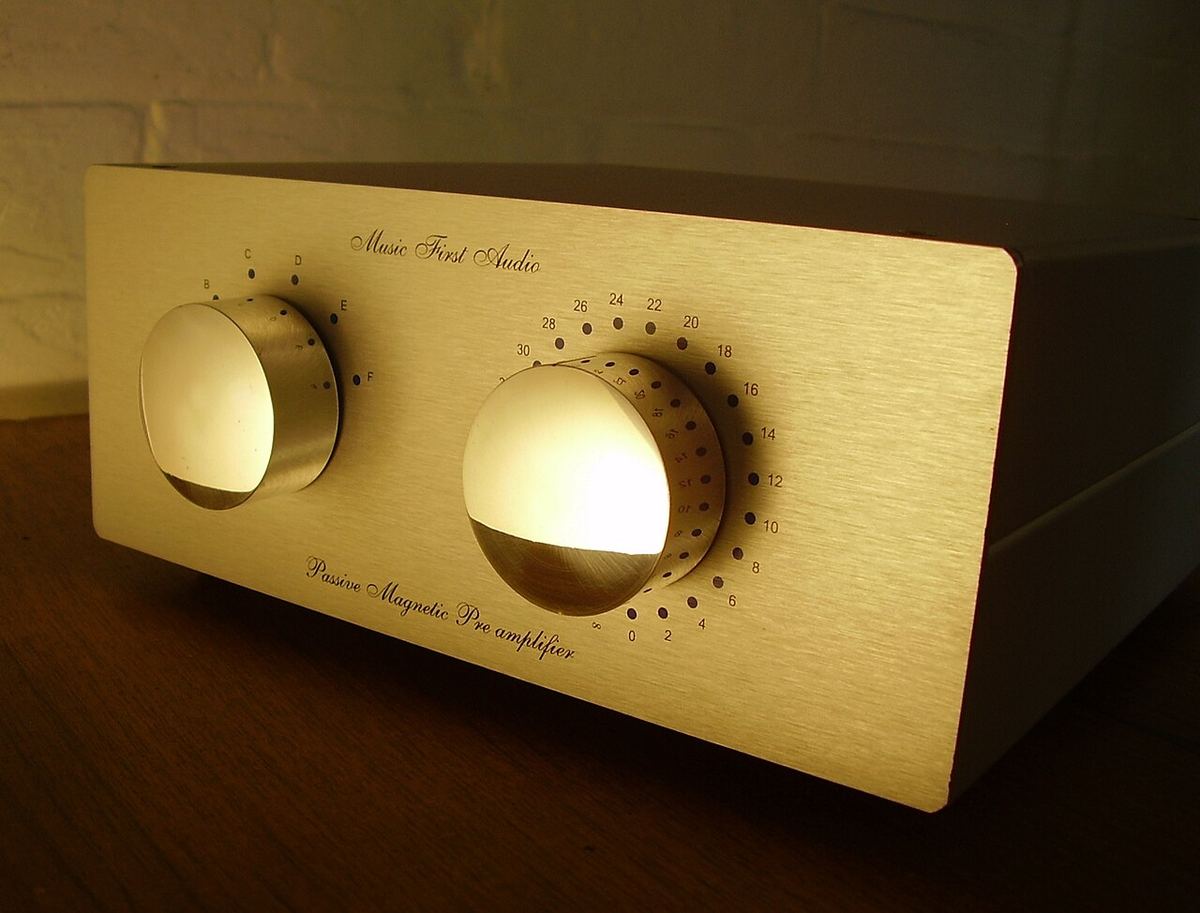
A passive preamplifier is essentially a switch and an attenuator, with no active devices at all. It cannot add gain — it can only reduce — and its supporters value the absence of any amplification stage in the path. Given modern 2 V sources and sensitive power amplifiers, the lack of gain is often not a problem at all.
The problem is impedance, and it is subtle because it changes with the volume setting. A passive volume control's output impedance is highest around the middle of its range — typically a quarter of the potentiometer's total value — so a 50 kΩ passive can present around 12.5 kΩ at moderate volume. Into a power amplifier with a 10 kΩ input, that is a serious mismatch that varies as you turn the knob. Passive preamplifiers work beautifully in the right system — short cables, high-impedance amplifier input, healthy source output — and disappointingly in the wrong one.
Before choosing passive, check three numbers: the source's output impedance (under about 600 Ω is comfortable), the power amplifier's input impedance (47 kΩ or higher is ideal, 10 kΩ is a warning), and the interconnect length (keep it short, since cable capacitance combines with the attenuator's impedance to roll off treble). Meet all three and a passive is an elegant solution; fail one and an active preamplifier is the right answer.
Volume Controls Are Not All Alike
The volume control is the component you touch most and the one where implementation varies most widely.
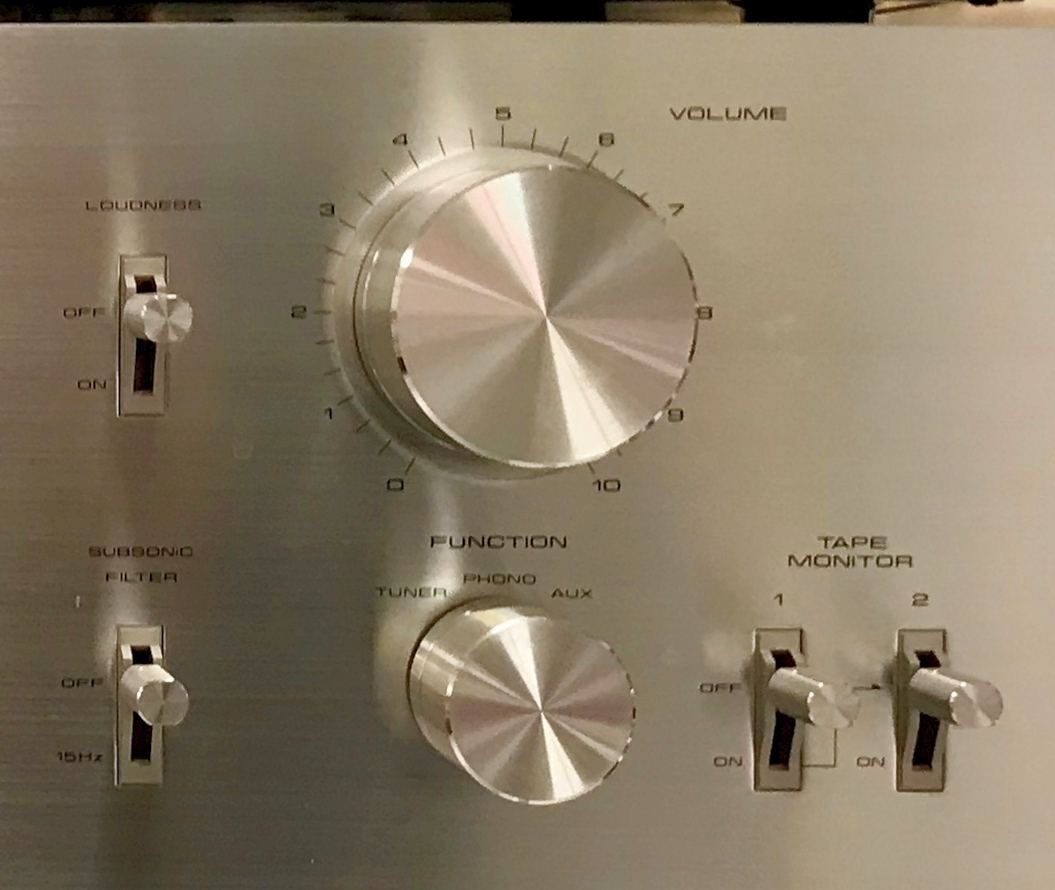
A potentiometer is a continuously variable resistive track, and it is the standard for good reason: simple, cheap and smooth. Its weakness is channel matching — the two tracks are never identical, and the mismatch is worst at low settings, which is exactly where many people listen. A good potentiometer holds tracking to within a fraction of a decibel; a poor one can be a decibel or more out at low volume, pulling the image sideways.
A stepped attenuator replaces the track with a switch selecting between fixed, precision resistors. Channel matching becomes as good as the resistors, which is excellent, and there is no wiper to wear or become noisy. The trade is discrete steps — usually 1 or 2 dB — which occasionally leaves the ideal level between two positions.
A relay-switched resistor ladder is the modern refinement: the same precision-resistor principle, but switched electronically under microprocessor control, allowing remote operation and fine steps with excellent matching. Digital volume control, performed in the DAC before conversion, is a different approach entirely; done at high internal resolution it is transparent, though at very low settings in a low-resolution implementation it can cost you bits.
Do You Actually Need One?
Many systems do not, and it is worth being honest about which do.
An integrated amplifier contains a preamplifier stage already, and in a single box the designer controls the interface between preamp and power sections completely — no interconnect, no impedance guesswork, no extra chassis. For most systems this is the sensible answer, and the money saved on a second box and its power supply buys real quality elsewhere.
A DAC with a volume control can drive a power amplifier directly, removing the preamplifier from the chain altogether. This works well when the DAC's analogue output stage has a genuinely low output impedance and the volume control is implemented properly. Check both: some DACs' variable outputs are designed for headphones or short runs and struggle with a real amplifier input at the end of a cable.
A separate preamplifier earns its place when you need many inputs with different levels, when the power amplifiers sit far from the listening position so long interconnects are unavoidable, when you want to mix technologies (a valve preamplifier with solid-state power, for instance), or when you are building towards monoblocks. Those are real reasons; "separates are inherently better" is not one, and a good integrated will beat a mediocre pre-power pair at the same total price.
Reading the Specification
A handful of numbers tell you almost everything about whether a preamplifier will work in your system.
- Output impedance — under 600 Ω is comfortable with almost anything; check it against your power amplifier's input impedance using the rule of ten.
- Input impedance — 47 kΩ is the usual line-level standard and is generous for any modern source.
- Gain — anywhere from 0 dB (unity, effectively a buffered passive) to about 12 dB. Too much gain in a system that does not need it just means listening with the control at eight o'clock, where channel matching is worst.
- Maximum output voltage — must comfortably exceed what your power amplifier needs for full output.
- Noise floor — matters most with high-gain preamplifiers into sensitive amplifiers and efficient speakers, which is the combination that produces audible hiss at the listening seat.
Gain Structure: A Worked Example
Too much gain is the most common preamplifier mismatch, and it is worth working through why. Take a 2 V source, a preamplifier with 12 dB of gain, and a power amplifier that reaches full output with 1.5 V at its input.
With the volume control fully open, the preamplifier could deliver 8 V — about 14.5 dB more than the power amplifier needs to clip. So full output is reached with the volume control already 14.5 dB down. Normal listening typically sits 20–30 dB below full output, which puts the control at roughly 35–45 dB of attenuation: the bottom quarter of a potentiometer's travel, where channel matching is poorest and small movements make large changes in level.
Replace the preamplifier with a unity-gain design and the same listening level falls about 12 dB further up the control's range, where matching is better and adjustment is finer. The preamplifier's own noise is no longer amplified by 12 dB either. With modern sources and sensitive power amplifiers, low gain is usually an advantage rather than a limitation; generous gain is for systems with low-output sources or insensitive power amplifiers.
Balanced Preamplifiers
Many preamplifiers offer XLR outputs, and two points are worth knowing. First, balanced outputs typically deliver twice the voltage of the RCA outputs — 6 dB more — because the signal appears in both polarities, so a source producing 2 V on RCA usually produces 4 V on XLR. That extra level worsens the gain-structure problem above unless the power amplifier's balanced input is correspondingly less sensitive, which many are.
Second, not every XLR socket indicates a balanced circuit. A fully balanced preamplifier carries two complete signal paths throughout; others are single-ended internally and convert to balanced at the output. Both deliver the main practical benefit of a balanced connection, which is noise rejection over long interconnects. The difference matters mainly in specifications and price, not in whether the connection works.
Home Theatre Bypass
Systems that share speakers between music and films raise a particular problem: two volume controls in series. If an AV receiver's front-channel outputs pass through a stereo preamplifier, the stereo preamplifier's volume has to be set to the same position every time a film is played, or the front speakers will be mismatched against the centre and surrounds.
A home theatre bypass (or unity-gain) input solves this by fixing the preamplifier's gain at unity for that input, handing volume control entirely to the AV processor. If you plan to integrate a stereo system with a surround setup, it is one of the most useful features to look for, and far more practical than trying to remember a reference volume setting.
Quick Reference: Preamplifier Types
| Type | Gain | Output Impedance | Best Suited To |
|---|---|---|---|
| Active (solid-state) | Typically 6–12 dB | Low and constant | Long cables, low-impedance amplifier inputs, mixed sources |
| Active (valve) | Often higher | Higher; check against the amplifier | Systems chosen as a matched pair; needs the rule of ten applied |
| Passive attenuator | None — attenuation only | Varies with setting; peaks mid-range | Short cables, healthy source, high-impedance amplifier input |
| Integrated amplifier's preamp stage | Designed for its own power stage | Internal — not a concern | Most systems; no interface to get wrong |
| DAC with variable output | Usually unity or less | Depends on the analogue stage | Digital-only systems with a capable output stage |
Check gain and impedance through your chain
Enter your source, preamplifier and power amplifier for a free analysis of gain structure, impedance matching, and where the chain is losing headroom.
Run a Free Analysis →