
More Guides
Why I Ran My Own System Through It
This site's analyzer reads the published specifications of each component and checks how every connection in the chain fits together: voltage, impedance, formats, gain and cartridge resonance. I built it around the system I own, so it seemed fair to point it at that system and see whether its verdicts hold up.
How to read this page: the findings below are the analyzer's automated output from a run on November 9, 2026, using the live site. They come from published specifications, not from listening. The comments marked My take are mine. The analyzer is partly AI-generated, so another run can word things differently.
The System
Nine components, plus a power conditioner. Most were bought used, which is the strategy in the used + new guide.
- Vincent SV-237MK integrated amplifier (used). It sits on a Furman power conditioner.
- DALI Rubicon 5 speakers (new, discontinued stock, discounted).
- Schiit Mimir DAC (used, with the Forkbeard, which is part of the Mimir). I power it with the Mimir's wall-wart.
- NAD C538 CD player (factory refurbished, discounted).
- Silent Angel M1T streamer (used).
- Apple iPad, 9th generation (used), as a USB source.
- Fluance RT-85 turntable (used) with a Denon DL-301 II cartridge (new).
- Parasound zPhono XRM phono preamp (used).
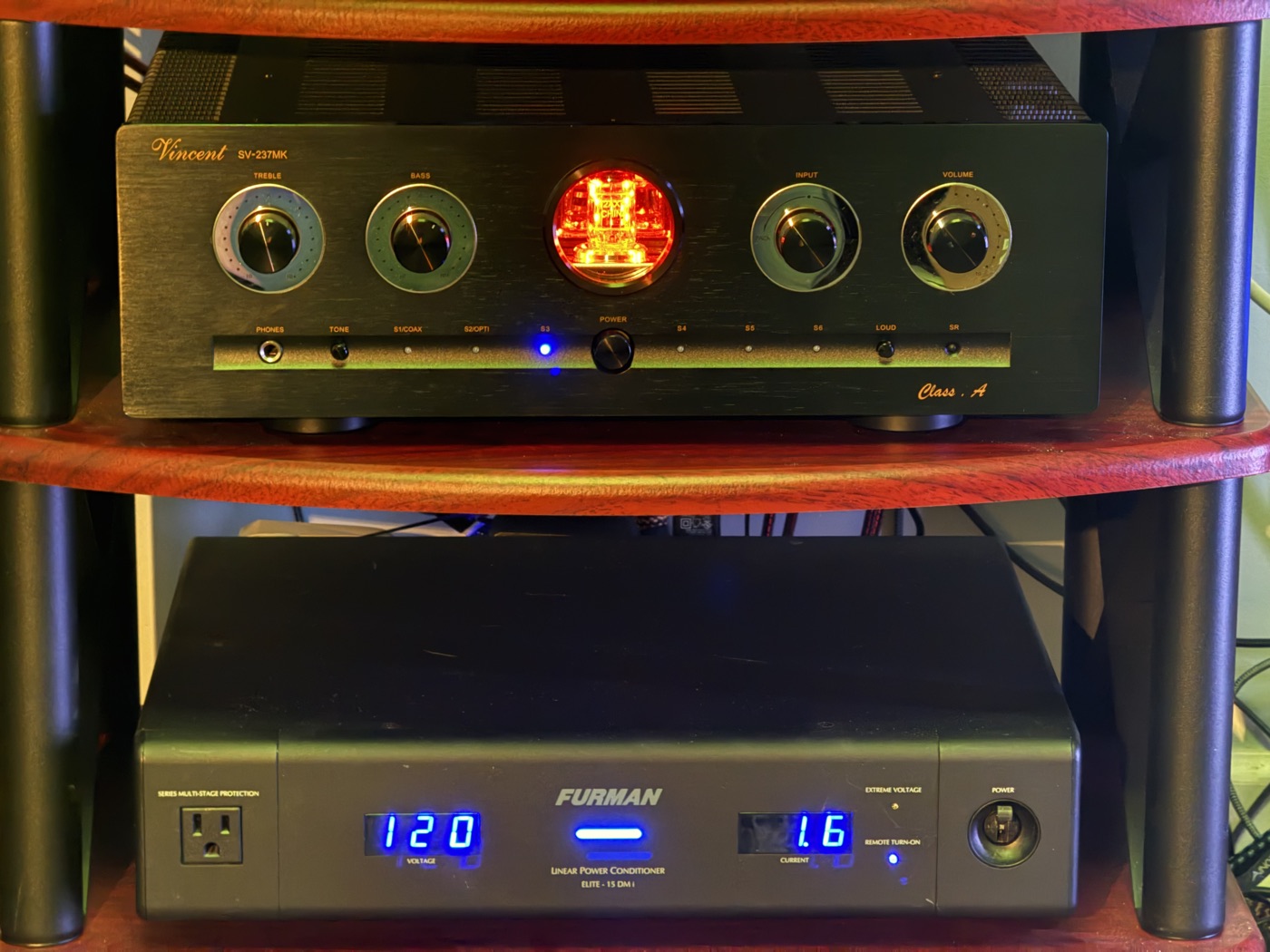
I connect the speakers with World's Best Cables (WBC) Ultimate Series speaker cables: 9 AWG oxygen-free copper with banana plugs, per the listing.
The Signal Chain
This is the diagram the analyzer drew from the connections I entered. Each line is one cable, and its color shows the cable type.
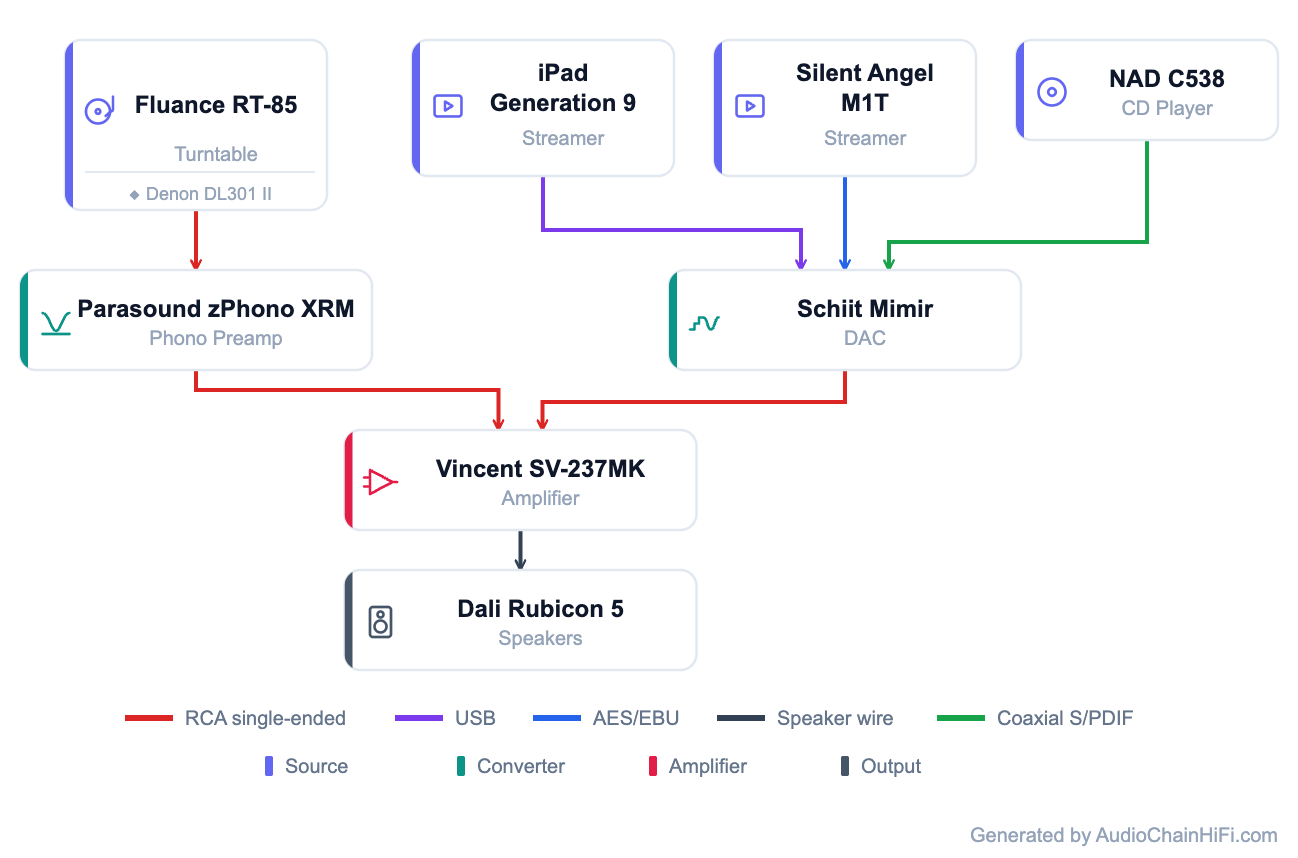
The digital sources all feed the Mimir: the iPad over USB, the M1T over AES/EBU and the C538 over coaxial. The Mimir and the zPhono both feed the Vincent over RCA. The Vincent has no phono input, so the zPhono does the phono work.
The Result: 7/10
- Overall score: 7/10
- Impedance match: Good
- Sensitivity match: Good
The analyzer found no incompatible link. The points it raised were settings to check and limits to know about, covered below.
The Phono Chain
Gain, loading and tracking force
The Denon DL-301 II is a moving-coil cartridge with a 0.4 mV output. The analyzer recommended the zPhono's MC input at 60 dB gain, which lifts the signal to about 400 mV, above the Vincent's 300 mV input sensitivity. It suggested a loading of 100 Ω or higher, a tracking force of 1.4 g, and the rumble filter if needed.
My take: that matches how I run it: the MC input, 60 dB gain and the rumble filter on. I load the cartridge at about 400 Ω, which I set by ear. Denon's recommendation is 100 Ω or more, so 400 Ω is inside it.
Resonance
With the RT-85's 27.5 g effective arm mass and the DL-301 II's 6 g and 13 µm/mN compliance, the formula gives 7.5 Hz, which it rates Borderline because it is just under the 8–12 Hz target. The cartridge's 6 g is inside the arm's 5–7.5 g supported weight range. I explain the calculation in the cartridge guide.
A note on entering a turntable and cartridge
In my first run I drew a cable from the cartridge to the turntable. The analyzer then worried that the RT-85's 5.5 mV phono output is MM-level and suggested the table might be in the wrong signal path. Without that cable, it correctly noted that the 5.5 mV figure belongs to the table's own cartridge, and that the MC input is right for the Denon. For the run on this page I left that cable out.
The Digital Chain
The AES limit
The M1T's AES/EBU output supports PCM up to 384 kHz and DSD128, but the Mimir's AES input stops at 24-bit/192 kHz, so anything higher, and DSD, cannot pass over that link. The analyzer suggested the M1T's USB output as the way around it, since the Mimir's USB input accepts up to 384 kHz.
My take: I can't use USB for the M1T right now because the iPad is plugged into the Mimir's USB input. So AES is my link, and 24/192 is my ceiling.
Powering the Mimir
The analyzer warned that the Mimir reports 500 mA when it is powered over USB, which a source like the iPad may not be able to supply, and suggested its wall-wart, which reports 0 mA. My take: I already use the wall-wart, so that warning does not apply to me.
CD player
The C538's coaxial output carries 16-bit/44.1 kHz, well inside the Mimir's coaxial input limit of 24-bit/192 kHz. The analyzer notes that the Mimir's own converter (118 dB S/N, 0.0003% THD+N) replaces the C538's built-in one on this link. I haven't compared the two.
Mimir, Amplifier and Speakers
The Mimir's 75 Ω output into the Vincent's 47 kΩ input is no concern. The Mimir's single-ended output reaches 2.0 V RMS with the wall-wart, far above the Vincent's 300 mV sensitivity, so the analyzer advised care with volume. My take: the Vincent handles the volume.
The Vincent delivers 2 × 250 W into 4 Ω and 2 × 150 W into 8 Ω. The Rubicon 5 is a 4 Ω speaker with 86 dB sensitivity and a recommended amplifier power of 60–150 W, so the amplifier covers it with room to spare. For the speaker cable the analyzer recommended heavy-gauge, short runs because of the 4 Ω load. My 9 AWG cables are heavy gauge.
Did It Surprise Me?
No. None of the verdicts surprised me. Looking back over the output, what it flagged were settings to check and limits to know about: the cartridge loading, the AES limit and the Mimir's power source.
What the analyzer can't do is tell you how a system sounds. It works from published specifications, so it can rule out mismatches but it can't tell you whether you will like the result. I made my own choices by listening, which is in the DAC, amplifier and speaker guides.
Run your own system through it
Enter your components and connections to get the same kind of link-by-link analysis, for free.
Run a Free Analysis →