
Headphone specifications look similar to speaker specifications — impedance, sensitivity, frequency response — but they are used and interpreted differently. A speaker amplifier rated at 100 watts is usually far too powerful for headphones; a phone's headphone output is usually far too weak for high-impedance audiophile headphones. The compatibility chain matters as much for headphones as for any loudspeaker system.
Impedance: High vs Low
Headphone Impedance (Ω)
Consumer and portable headphones typically measure 16–64 Ω. Studio and audiophile headphones commonly range from 80 to 600 Ω. The impedance affects how much voltage is needed to drive the headphone to a given sound pressure level. A 300 Ω headphone needs six times the voltage of a 50 Ω headphone to produce the same current through the voice coil. This means high-impedance headphones require an amplifier capable of higher output voltage — a specification that is rarely emphasised in consumer electronics, but which determines whether the amplifier can drive the headphone to satisfying volume levels.

Low-impedance headphones (16–32 Ω) are generally easier to drive to loud levels from a phone or laptop headphone output, but they draw more current. They are also more sensitive to the output impedance of the source — which is covered below. High-impedance designs (150–600 Ω) typically offer lower distortion at high signal levels and are more tolerant of output impedance mismatches, but require a dedicated headphone amplifier for best performance.
Sensitivity: Two Different Rating Systems
Sensitivity: dB/mW vs dB/V
Headphone sensitivity is specified in one of two ways: dB SPL per milliwatt (dB/mW) or dB SPL per volt (dB/V). These are not interchangeable. For a 32 Ω headphone, 100 dB/mW equals 115 dB/V. For a 300 Ω headphone, 100 dB/mW equals only 107 dB/V. Always check which convention the manufacturer uses before comparing sensitivity figures across products with different impedances. The dB/V convention is more useful for matching to a source amplifier, since amplifiers are voltage sources. The dB/mW convention tells you about efficiency relative to power.
A useful rule of thumb: to achieve 110 dB SPL (a reasonable maximum listening level), subtract the sensitivity figure in dB/V from 110, divide the result by 20, and raise 10 to that power. The answer is how many volts RMS the amplifier must deliver. A headphone rated 105 dB/V needs 105/20 ≈ 1.8 V RMS for 110 dB SPL. A headphone rated 95 dB/V needs 1015/20 ≈ 5.6 V RMS — well beyond any phone and more than many compact desktop sources can supply. High-impedance, low-sensitivity headphones (Sennheiser HD 800: 102 dB/V at 300 Ω) require a dedicated desktop amplifier with meaningful output voltage capability.
Output Impedance: The Critical Amplifier Spec
Amplifier Output Impedance and the 1/8 Rule
The amplifier's output impedance forms a voltage divider with the headphone's impedance. If the output impedance is a significant fraction of the headphone's impedance, the amplifier's output impedance interacts with the frequency-dependent variation in the headphone's impedance to alter the frequency response. The standard guideline — borrowed from loudspeaker amplifier design — is that the amplifier's output impedance should be no more than 1/8th of the headphone's minimum impedance. For a 300 Ω headphone, the amplifier output impedance should be ≤37 Ω. For a 32 Ω headphone, it must be ≤4 Ω.
Many consumer electronics have high output impedances from their headphone jacks: some portable media players measure 10–25 Ω. This is audible as tonal coloration on low-impedance headphones whose impedance varies with frequency (as most dynamic headphones do). The treble and bass response will shift depending on the interaction between the source output impedance and the headphone's impedance curve. A dedicated headphone amplifier typically has an output impedance well below 1 Ω.
Hiss from background noise: A sensitive low-impedance headphone (16–32 Ω, 110+ dB/mW) will reveal the noise floor of almost any amplifier. If you hear hiss at zero volume, the amplifier's noise is being exposed by the headphone's high sensitivity. More gain than needed for comfortable listening is the usual cause.
Planar Magnetic Headphones: What They Need
Planar Magnetics: Low Impedance, Low Sensitivity
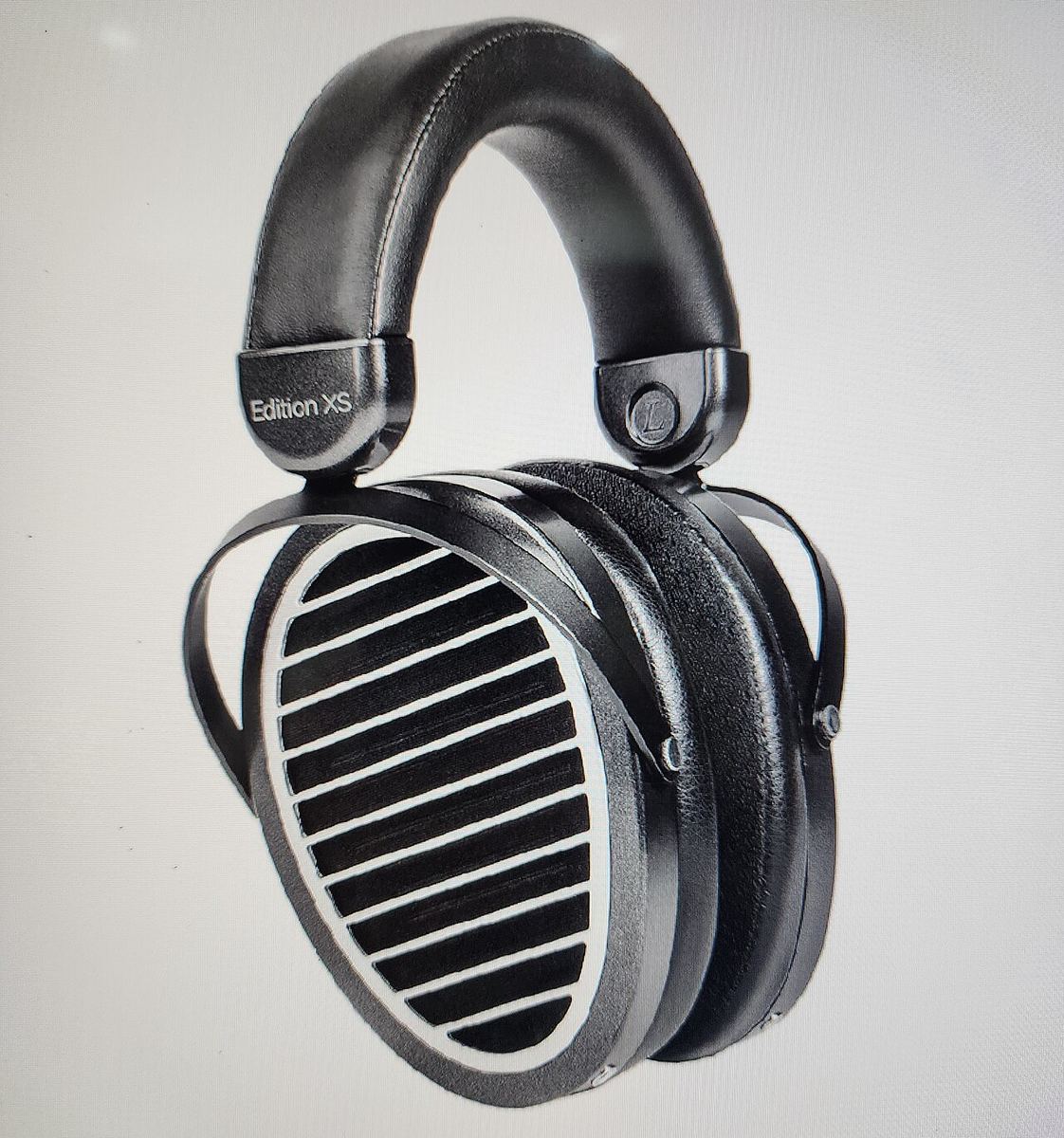
Planar magnetic headphones use a thin membrane with embedded conductors suspended between magnets, rather than a voice coil in a magnetic gap. They typically have low impedance (20–50 Ω) and low sensitivity (85–95 dB/V) — meaning they require an amplifier that can deliver both significant current (for the low impedance) and significant voltage swing (for the low sensitivity). Many planar magnetics are described as "hard to drive" not because of their impedance but because of the combination of low sensitivity and the current required. A desktop amplifier with at least 1 W of output into their impedance is usually a minimum requirement.
Frequency Response and Target Curves
A headphone's frequency response is not meant to be flat in the way a loudspeaker's is. Sound from speakers reaches your eardrum after being shaped by your head, shoulders and outer ear; a headphone bypasses much of that path, so its response has to recreate the effect. Researchers have proposed several "target curves" for doing so. The diffuse-field target models sound arriving from all directions, while the Harman target, developed through listener-preference research, adds a modest bass shelf and adjusts the upper midrange; it has become a common reference in measurements.
Two cautions apply when reading headphone graphs. First, measurements are made on artificial ears and head simulators, and results differ between rigs, so compare graphs from the same source. Second, your own ear shape changes what reaches your eardrum, especially above a few kilohertz. A measured treble peak may or may not be audible to you in the same way. Graphs are best used to spot large departures, such as a big bass boost or a strong peak around 3–8 kHz that often reads as harshness or sibilance.
Fit, Seal and Comfort
How a headphone sits on your head changes how it sounds. Closed-back and many over-ear designs rely on a good seal around the ear for their bass: glasses arms, hair, or a loose clamp can break the seal and drain bass noticeably. Ear pads matter acoustically as well as for comfort, since their depth, material and shape affect the distance and angle of the driver to your ear. Replacement pads from a different manufacturer can therefore change the sound as well as the feel.
Comfort decides whether a headphone gets used. Weight, clamping force, headband padding and pad material (velour breathes, leather and protein leather seal better but run warmer) all matter over a long listening session. If possible, wear a pair for at least half an hour before buying. The open-back vs closed-back guide covers how cup design shapes both sound and isolation.
Balanced Headphone Connections
Many headphone amplifiers and portable players now offer a balanced output, usually as a 4.4 mm Pentaconn jack, a 4-pin XLR, or the older 2.5 mm TRRS. In a balanced headphone connection, each earcup's driver is driven by its own pair of amplifier outputs, with no ground wire shared between left and right.
The practical benefits are specific. A balanced output typically delivers twice the voltage of the same device's single-ended output, which helps with high-impedance or low-sensitivity headphones. Removing the shared ground also eliminates a source of crosstalk between channels. It is not a different sound in itself; a single-ended output that already has enough voltage and low output impedance will not be improved simply by switching connectors. Using a balanced output does require a headphone cable wired for it, and many headphones with detachable cables can be fitted with one.
Wireless and USB Headphones
Bluetooth and USB headphones change the compatibility picture completely. They contain their own DAC and amplifier, designed for those specific drivers, so impedance, sensitivity and source output impedance no longer need matching. Sound quality then depends on the headphone's internal electronics and, for Bluetooth, the codec in use. SBC is universal; AAC works well with Apple devices; aptX variants and LDAC offer higher bit rates where both ends support them. Active noise cancellation adds processing that most listeners accept for travel and commuting, at some cost to absolute fidelity.
Listening Safely
Headphones make it easy to listen loudly for long periods without noticing, because there is no room or neighbour to signal how loud it is. The occupational guideline from NIOSH (the US National Institute for Occupational Safety and Health) is 85 dBA for eight hours, with the safe time halving for every 3 dB increase: 88 dBA for four hours, 94 dBA for one hour, and so on. Ringing in the ears or a muffled feeling after listening are signs of temporary over-exposure. Choosing headphones with good isolation helps here, because you are less tempted to raise the volume to cover background noise.
Quick Reference: Headphone Specs at a Glance
| Specification | What It Means | What to Look For |
|---|---|---|
| Impedance | Electrical resistance of the headphone | Low (≤50 Ω): easy to drive; High (150+ Ω): needs amplifier voltage |
| Sensitivity (dB/V) | SPL per volt at the headphone terminal | Higher = easier to drive; check units match |
| Sensitivity (dB/mW) | SPL per milliwatt into the headphone | Comparable only within same impedance class |
| Amplifier Output Impedance | Source impedance forming voltage divider with headphone | ≤1/8th of minimum headphone impedance |
| Amplifier Output Voltage | Maximum voltage swing available | Must reach 110 dB SPL at your headphone's sensitivity |
| Driver Type | Dynamic or planar magnetic | Planars need current + voltage; dynamics need voltage primarily |
Check your headphone chain compatibility
Enter your headphones and source or amplifier to get a full analysis of output impedance ratio, voltage requirements, and signal-to-noise ratio.
Run a Free Analysis →