
Audio cables operate at frequencies well below the point where transmission-line effects, skin effect, or dielectric absorption are significant. In a correctly designed system, a well-made cable of any reasonable construction will measure identically to any other cable of equivalent gauge and length. The specifications that can affect performance are capacitance (for interconnects), resistance (for speaker cables), and shielding quality. Everything else is marketing.
Interconnect Capacitance
Cable Capacitance (pF/metre)
An interconnect cable has capacitance between its signal conductor and shield. This capacitance forms a low-pass filter in combination with the source component's output impedance: the −3 dB frequency is 1 ÷ (2π × R×C), where R is the output impedance in ohms and C is total cable capacitance in farads. For most line-level sources with output impedances of 100–600 Ω and cable capacitances of 50–150 pF/metre, this rolloff point is well above 100 kHz even at several metres — inaudible. However, a high-output-impedance valve preamplifier (2–10 kΩ) driving a long cable can produce a high-frequency rolloff that is audible. In this case, choosing a lower-capacitance cable matters.
Phono cables are a special case. The capacitance of the tonearm cable contributes to the total capacitive load on a moving-magnet cartridge and affects frequency response near the resonant peak. See the Phono Stage Guide for detail. Typical tonearm cables measure 100–200 pF total; the remainder of the budget goes to the phono stage's input capacitance.
When cable capacitance matters: High-output-impedance sources (tube preamps, passive volume controls) + long cable runs (3+ metres) + high-capacitance cables (>200 pF/metre). In any other situation, cable capacitance at audio frequencies is irrelevant.
Interconnect Resistance
DC Resistance (Ω)
The resistance of an interconnect cable forms a voltage divider with the input impedance of the destination component. A typical line-level input impedance is 10–47 kΩ. Even a high-resistance cable of 10 Ω represents a voltage loss of only 0.02% into a 47 kΩ load — utterly inaudible. Interconnect resistance is not a meaningful performance variable for any cable with a correctly soldered, corrosion-free connector. What matters is the connection quality at the plug, not the wire itself.
Speaker Cable Resistance
Loop Resistance (Ω) and Wire Gauge (AWG)
Speaker cables carry significant current and connect to low-impedance loads (typically 4–8 Ω). The cable's resistance is in series with the amplifier's output impedance and the speaker load. Excessive resistance reduces damping factor — the amplifier's ability to control the speaker cone — and causes a frequency-response deviation because a speaker's impedance varies with frequency. The guideline is to keep total speaker cable resistance below 5% of the minimum speaker impedance. For an 8 Ω speaker, keep cable resistance below 0.4 Ω total (both conductors). 16 AWG copper measures approximately 0.013 Ω per metre per conductor; 14 AWG approximately 0.008 Ω/metre. For most runs under 5 metres, 16 AWG is adequate. For runs over 10 metres or 4 Ω speakers, 14 AWG or heavier is warranted.
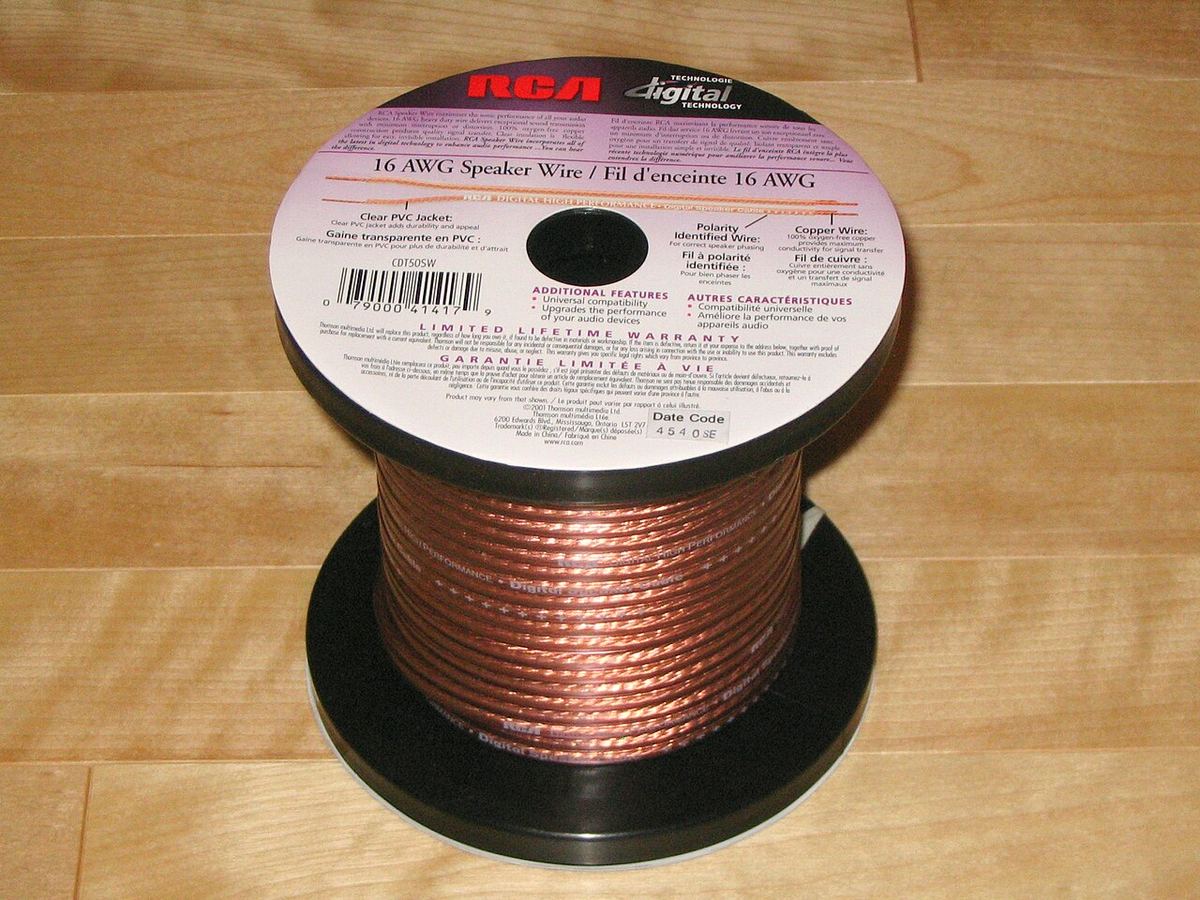
| AWG | Resistance per metre (each conductor) | Max run for 8 Ω speaker (<5% rule) |
|---|---|---|
| 24 AWG | 0.084 Ω/m | 2.4 m |
| 20 AWG | 0.033 Ω/m | 6 m |
| 18 AWG | 0.021 Ω/m | 9.5 m |
| 16 AWG | 0.013 Ω/m | 15 m |
| 14 AWG | 0.008 Ω/m | 24 m |
| 12 AWG | 0.005 Ω/m | 38 m |
Shielding
Shield Coverage and Type
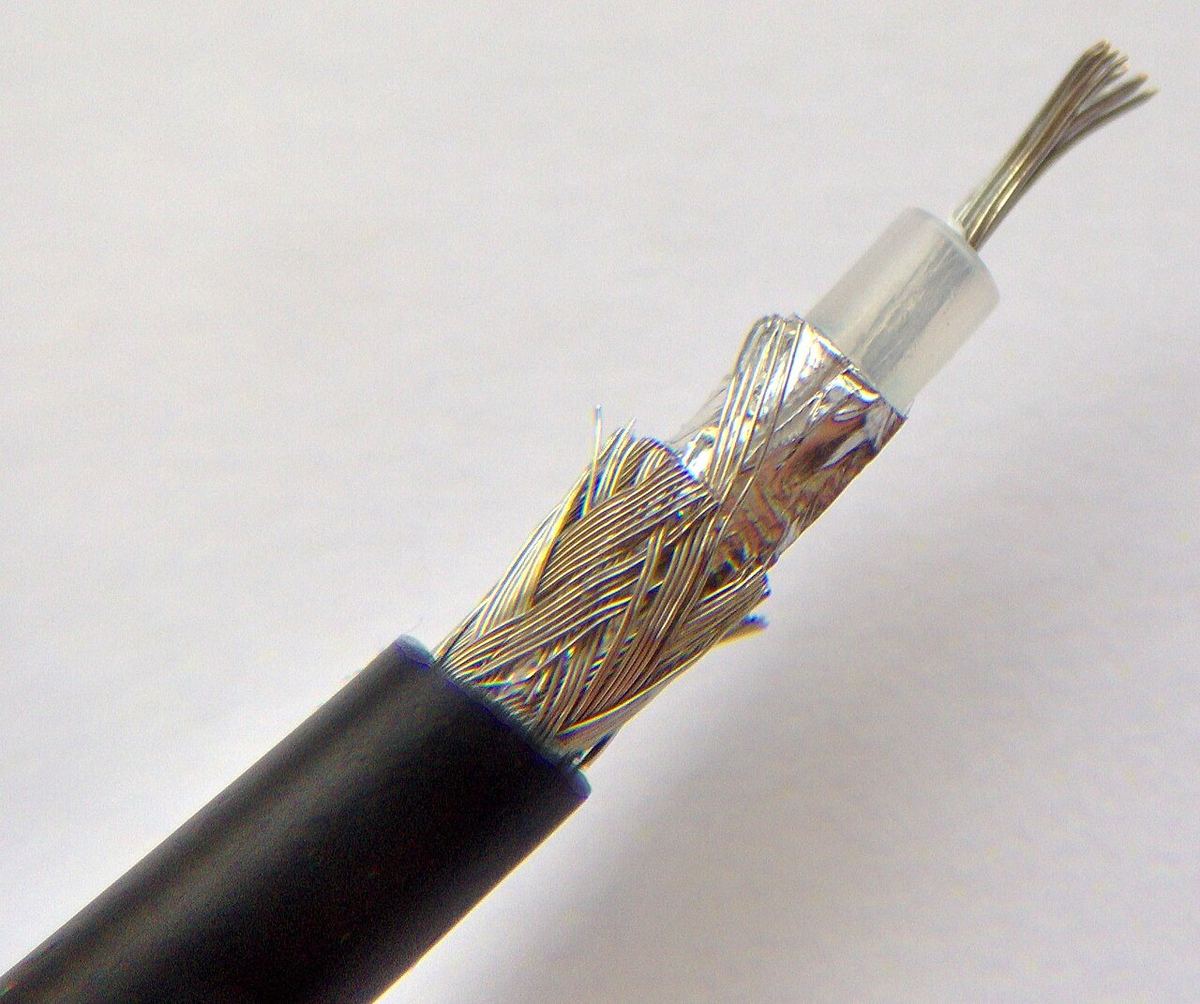
Interconnect cables carrying low-level signals (phono, microphone, unbalanced line) require shielding to reject electromagnetic interference (EMI) and radio-frequency interference (RFI). A braided shield provides good coverage (typically 90–98%) and is mechanically robust. A spiral (serve) shield offers flexibility with slightly lower coverage. Foil shields provide 100% coverage but are less flexible and can develop microphonic noise in moving applications. For a fixed hi-fi installation, any shielded cable with >85% coverage is adequate. The shield must be connected at one end only in a single-ended (RCA) installation to avoid ground loops — though most modern hi-fi components handle this internally.
Balanced (XLR) interconnects are inherently less susceptible to interference because they reject common-mode noise through differential signalling. If EMI or hum is a problem in a system, converting to balanced connections where the components support it is more effective than upgrading cable shielding.
What Does Not Affect Sound
The following cable properties have no measurable or audible effect in a correctly operating audio system at the impedance levels and frequencies involved:
- Conductor material — silver, copper, and gold have conductivities within a factor of 2 of each other; the resistance differences are inaudible at the lengths used
- Dielectric material — dielectric absorption effects appear at RF frequencies, not audio frequencies
- Strand geometry — Litz wire, solid-core, stranded wire are equivalent at audio frequencies
- Directionality — there is no physical mechanism by which a passive conductor has an audio-frequency direction
- Inductance — speaker cable inductance causes a treble rolloff only at far higher frequencies than the audio band, and only with unusually long runs of very high-inductance cables
Connectors and Termination
A cable is only as good as its connections, and a poor termination causes far more real problems than any difference in wire. Speaker cable can be fitted with banana plugs, spade connectors, or used as bare wire clamped directly in the binding post:
- Bare wire makes an excellent connection if the strands are twisted tight, inserted fully and clamped firmly. Check for stray strands, which can short positive to negative and trigger an amplifier's protection circuit, or damage an amplifier that lacks one.
- Banana plugs are convenient for frequent reconnection and avoid stray strands entirely. Make sure they fit the binding posts snugly.
- Spades give a large contact area when clamped under a tight binding post, and suit terminals that do not accept bananas.
Exposed copper oxidises over months and years, darkening and raising contact resistance slightly. Re-cutting and re-terminating bare wire occasionally, or using plated connectors, keeps the connection clean. Tighten binding posts by hand, firmly but not with tools, which can crack the plastic.
Balanced Cables and Adapters
Balanced XLR cables are standardised (pin 1 ground, pin 2 hot, pin 3 cold), and any correctly wired cable of reasonable quality performs the same. Adapting between balanced and unbalanced equipment needs more care. Connecting a balanced output to an unbalanced input means deciding what happens to the cold leg: depending on the output stage design, it should either be connected to ground or left floating, and the wrong choice can lose 6 dB, add noise, or in rare cases stress the output stage. Follow the equipment manufacturer's guidance, or use an adapter cable they recommend. The balanced vs unbalanced guide explains the underlying mechanism.
Digital and USB Cables
Digital cables have different requirements from analog ones. A coaxial S/PDIF cable should be a true 75 Ω design, such as video-grade coax, rather than an ordinary analog interconnect, because an impedance mismatch causes reflections that can add timing jitter at the receiver. A USB audio cable needs to meet the USB specification and stay within its length limit — 5 m for USB 2.0 without an active extender. Beyond those requirements, a digital cable either delivers the data intact or fails obviously with dropouts; there is no gradual sonic degradation from an otherwise working cable. The digital connections guide covers each interface in detail.
Running Cables Safely and Neatly
- Keep signal cables away from mains leads where possible, and cross them at right angles where they must meet; running them side by side over a long distance invites hum.
- Use in-wall-rated cable for runs inside walls or ceilings. In North America, look for CL2 or CL3 ratings; other countries have their own fire-safety standards.
- Protect cables under rugs with flat cable or a cable protector, since repeated footfall damages insulation.
- Cut speaker cables to the length you need and keep left and right lengths roughly equal for tidiness. Coiling a little excess is harmless at audio frequencies; keeping left and right runs equal simply keeps the two channels electrically matched.
- Label both ends of every cable. It costs seconds and saves a great deal of time when you next change something.
Where Cable Money Is Well Spent
The engineering in this guide leads to a straightforward budget: buy speaker cable of adequate gauge for the run, well-made interconnects with solid connectors, and correct-spec digital cables, then stop. A reasonable allowance for a whole system's cabling is a small fraction of the cost of the electronics. The money saved does more as part of a better speaker, stands, or room treatment, which the budget allocation guide covers. The one place to spend a little more is mechanical quality: cables that are plugged and unplugged often benefit from robust connectors and strain relief.
Quick Reference: Cable Specs at a Glance
| Application | Spec That Matters | Guideline |
|---|---|---|
| Line-level interconnect | Capacitance (only with high Z source) | <100 pF/metre for valve or passive sources |
| Phono cable | Total capacitance (cable + stage) | Match MM cartridge spec; typically 100–300 pF total |
| Speaker cable | Loop resistance | <5% of minimum speaker impedance |
| Speaker cable gauge | AWG for run length | 16 AWG to 5 m; 14 AWG to 8 m; 12 AWG beyond |
| Any unbalanced cable | Shield coverage | >85% coverage; one-end ground in fixed install |
| Balanced (XLR) | Build quality | Correctly wired; no audible difference between brands otherwise |
Check your system's signal chain
Enter your components to get a full compatibility analysis — impedance ratios, gain staging, and whether your cable lengths and gauges fall within spec.
Run a Free Analysis →