
More Guides
Impedance is the one speaker specification that can actually damage hardware if you get it wrong. Sensitivity, frequency response, and power handling describe how a speaker sounds; impedance describes how hard it leans on the amplifier driving it. Connect a load an amplifier was never designed for — often by wiring a second pair of speakers in without thinking about it — and the amp doesn't sound bad so much as it shuts down, or slowly cooks itself. This guide is about that number: what it really represents, what the different ratings ask of your amp, and how series and parallel wiring change the load the amp sees.
What Impedance Actually Is
Impedance is the opposition a speaker presents to the alternating current an amplifier sends it, measured in ohms (Ω). Unlike the plain DC resistance you would read with a multimeter, impedance changes with frequency, because a speaker is not a simple resistor — it is a coil of wire moving in a magnetic field, wrapped in a cabinet and a crossover network. Each of those elements pushes back on the current differently depending on the note being played.
The practical consequence is that a speaker's impedance is a curve, not a point. Plot it across the audible band and you get a line that rises into peaks around the driver's resonance and the crossover points, and sags into valleys elsewhere. The single figure on the spec sheet is a summary of that entire curve — which is exactly why it can be misleading.
Nominal vs. Minimum: Why an "8Ω" Speaker Dips to 3Ω
Nominal Impedance vs. Minimum Impedance
Nominal impedance is a representative average of the whole curve — the "8 Ω" or "4 Ω" on the box. Minimum impedance is the lowest point that curve reaches. A speaker sold as 8 Ω nominal can easily drop to 3 Ω or lower at a particular bass frequency while climbing above 20 Ω elsewhere. Your amplifier meets the whole curve, so it is the minimum — not the nominal — that decides whether the pairing is safe.
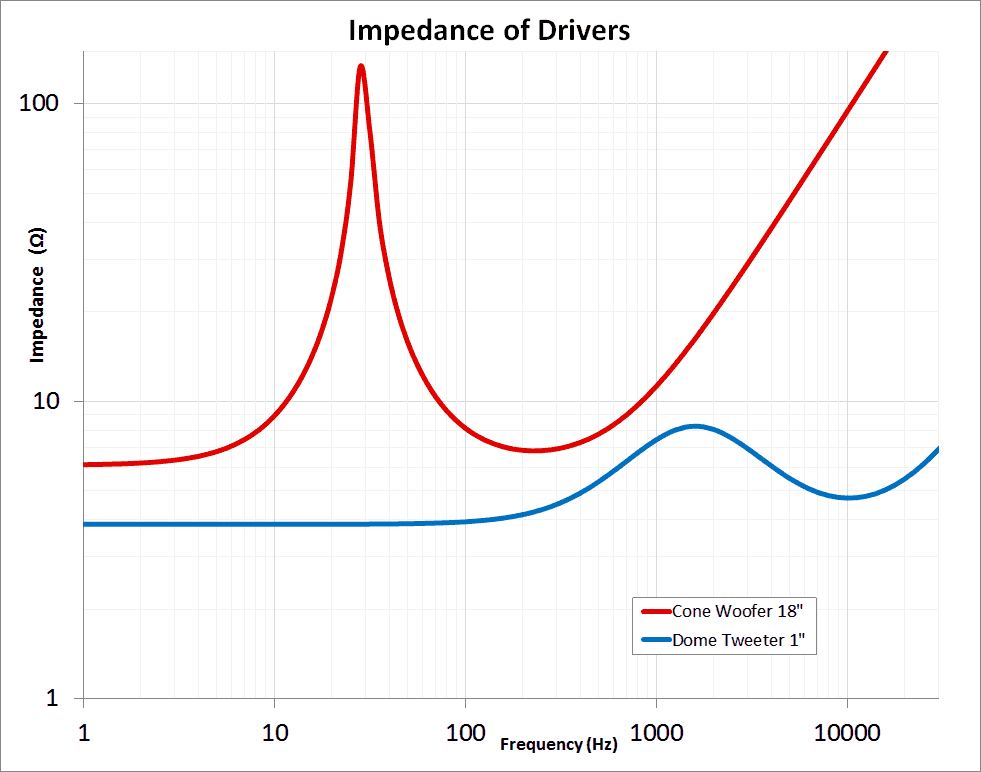
Manufacturers round toward the friendly number. A speaker whose curve spends most of its length near 6–8 Ω but dips to 3 Ω in the bass will still be labelled "8 Ω nominal," because that reflects the average and looks easier to drive. The amplifier, however, does not see an average. When the music hits the frequency where the curve bottoms out, the amp is momentarily driving a 3 Ω load and must supply the current that load demands — regardless of what the label promised.
This is why a good spec sheet lists both figures, and why the minimum is the number worth hunting for. If a manufacturer only publishes the nominal rating, treat a nominally 8 Ω speaker as if it could dip toward 4 Ω, and a nominally 4 Ω speaker as if it could approach 2 Ω. Plan around the harder case.
Rule of thumb: Match your amplifier to the speaker's minimum impedance, not its nominal rating. If you only know the nominal figure, assume the real dip is roughly one rating lower and choose an amp comfortable with that.
What 4, 6, and 8Ω Mean for Your Amplifier
Here is the counterintuitive part: a lower impedance is a harder load. Ohm's law explains why. For a given voltage, current rises as impedance falls. A solid-state amplifier holds its output voltage roughly constant and lets current follow the load, so halving the impedance roughly doubles both the current drawn and the power delivered. An amp rated 100 W into 8 Ω will try to deliver close to 200 W into 4 Ω — if its power supply and output devices can source that much current without overheating or hitting a limit.
That "if" is the whole story. More power into a lower impedance sounds like a bonus, but it is really a demand. A well-built amplifier that nearly doubles its power as impedance halves is telling you it has the current headroom to stay composed on difficult loads. An amplifier that delivers 90 W into 8 Ω and only 100 W into 4 Ω is current-limited — it runs out of current before it runs out of voltage, and it will strain on demanding speakers.
See the load your amp will actually see: If you plan to run more than one pair of speakers, the Speaker Impedance Calculator works out the combined ohms so you can check it against your amp's minimum before you wire anything.
| Nominal Rating | Typical Minimum Dip | What the Amp Needs |
|---|---|---|
| 8 Ω | ~5–6 Ω | Easy load — almost any amplifier is comfortable |
| 6 Ω | ~4 Ω | Moderate — most amps handle it; check the 4 Ω rating exists |
| 4 Ω | ~2.5–3 Ω | Demanding — amp should be explicitly rated stable into 4 Ω |
| Two 8 Ω pairs, parallel | ~4 Ω combined (can dip lower) | Treat as a 4 Ω load; a receiver rated 8 Ω only may protest |
Series vs. Parallel: Wiring More Than One Speaker
The moment you connect a second speaker to the same amplifier output, the amp stops seeing one speaker and starts seeing the combination. How you wire the two together decides whether that combination is an easier load or a dangerously harder one. There are two ways to do it, and they move the impedance in opposite directions.
Series Wiring Adds Impedance
Wire two speakers end to end — the amplifier's output through the first speaker, on to the second, and back — and their impedances add. Two 8 Ω speakers in series present 16 Ω to the amplifier. The load gets easier, but the trade-off is that the shared current means each speaker receives less power, so overall output drops.
Parallel Wiring Divides Impedance
Wire both speakers directly across the same amplifier terminals — both positives together, both negatives together — and the impedance divides. Two 8 Ω speakers in parallel present just 4 Ω. Two 4 Ω speakers in parallel drop to 2 Ω. This is the wiring that gets people in trouble, because it pushes the load down, toward or past the limit the amplifier can safely drive.
The arithmetic is worth having in your head. In series, you simply add: 8 + 8 = 16 Ω. In parallel with two identical speakers, you halve: two 8 Ω becomes 4 Ω, two 6 Ω becomes 3 Ω. With unequal speakers the parallel result is smaller than the smaller of the two, which is why mixing an 8 Ω and a 4 Ω pair in parallel lands under 3 Ω — a load most home amplifiers are not built for. And remember these figures ride on top of the impedance dips already in each speaker: two speakers that each sag to 6 Ω in the bass are presenting the amp closer to 3 Ω there, not 4 Ω.
Two 8 Ω Speakers — How Wiring Changes the Load
Why a Load That's Too Low Overheats an Amp
When impedance falls below what an amplifier is designed to drive, the amp is asked for more current than its power supply and output transistors can source. Current produces heat in those output devices, and heat is the enemy. Below the amp's safe load, the transistors run hotter than their rating allows, and one of two things happens.
In a well-designed amplifier, a protection circuit intervenes first — sensing excess current or temperature and muting the output, sometimes cutting in and out on loud passages, sometimes shutting the amp down entirely until it cools. It is annoying, but it is the amp saving itself. In a lesser design, or one whose protection is defeated or absent, the output stage simply overheats until something fails. Either way the message is the same: the load is below what the amplifier can handle, and the fix is a higher impedance or an amplifier built for the lower one.
Watch for these signs of an overloaded amp: the chassis running unusually hot, sound dropping out on loud bass notes, the amp clicking off after a few minutes at volume, or a protection light coming on. All point to an impedance the amplifier cannot sustain.
Running Two Pairs of Speakers Safely
The most common way people end up with a too-low load is the "B speakers" scenario: a second pair for another room, or a stereo pair front and back. The safe approach depends on how those outputs are wired and rated.
- Check the amplifier's minimum impedance first. If it is rated only for 8 Ω loads, connecting two 8 Ω pairs in parallel drops it to 4 Ω — below spec. An amp rated stable into 4 Ω can usually manage a single parallel pair; going to 2 Ω is another step down again.
- Prefer series wiring if you must combine pairs on one output. Two 8 Ω speakers in series give a safe 16 Ω load, at the cost of some volume. Some "A+B" speaker selector boxes include protection resistors or switch the pairs into series for exactly this reason, but basic ones simply connect them in parallel — check which kind you have before relying on one.
- Use genuinely separate outputs where available. Some receivers give each speaker pair its own amplifier channel rather than paralleling them onto one, which keeps each load at its full impedance. Read the manual to find out which arrangement yours uses.
- Don't defeat the impedance switch. If your receiver has a 4 Ω/8 Ω setting, set it honestly for the combined load rather than forcing the higher setting for a little more volume.
How to Check Your Specific Case
Impedance problems are avoidable because the numbers are knowable in advance. Work through them in order:
- Find each speaker's nominal and minimum impedance. The nominal is on the box; the minimum is usually in the full specifications or a published measurement. If only the nominal is listed, assume the real dip runs about one rating lower.
- Find your amplifier's minimum stable impedance. Look for a phrase like "stable into 4 Ω" or a power figure quoted into 4 Ω. If the amp is only ever rated into 8 Ω, treat 8 Ω as its floor.
- Work out the combined load if you are wiring more than one pair. Add for series, divide for parallel — then compare that result against the amp's minimum.
- Leave margin for the dips. If the combined nominal load equals the amp's exact minimum, remember the real curve goes lower. Give yourself headroom.
Running the parallel or series arithmetic by hand is easy to get wrong once the speakers aren't identical. The calculator does it for you and flags when the result crosses into territory a typical amplifier won't like — which is the fastest way to sanity-check a plan before you strip any wire.
See the load your amp will actually see
Enter your speakers and how they're wired to get the combined impedance — series or parallel — and a clear read on whether it stays within your amplifier's safe range.
Open the Speaker Impedance Calculator →Impedance rewards a few minutes of arithmetic with years of trouble-free listening. Know each speaker's nominal and minimum ohms, know your amplifier's floor, do the series-or-parallel math before you connect a second pair, and leave room for the dips. Get those four things right and the load side of your system simply disappears as a concern — which is exactly what it should do. For the other half of the pairing, the speaker matching guide covers sensitivity and power, and the amplifier guide covers what to look for on the amp's side.